


Journal of Sustainable Cities and Built Environment
Volume 4, Issue 2, 2026, ISSN: 2536-0132

Original Article
Housing Crises Dynamics and Residential Aspirations Across Generations and Territorial Contexts: The Case of Réunion Island


Editor: Ashraf Mohamed Soliman 

Reviewers:
Islam Elghonaimy
Mahmoud Abdilatif
1 Physics and Mathematical Engineering Laboratory for Energy, Environment and Building (PIMENT), France
*Correspondence: email:pauline.lallemand@univ-reunion.fr, ORCID ID: https://orcid.org/0009-0003-8445-8691
Received 17 June 2026, Revised 30 June 2026, Accepted 01 July 2026, Available online 07 July 2026
DOI: https://doi.org/10.58757/jscbe.04.02.04
Abstract:
Housing crises are often discussed in terms of shortages, rising prices, and affordability. Yet they also reveal another, less visible reality: the growing distance between the homes people dream of and the homes they can actually access. This paper explores this tension in Réunion Island, a French overseas territory where housing shortages, social inequalities, and increasing land pressures make access to adequate housing increasingly difficult. Drawing on the concept of the aspirations gap, the study combines a quantitative analysis of housing conditions across the island with a qualitative exploration of residents’ housing aspirations. Principal Component Analysis (PCA) and Hierarchical Clustering identify five contrasting socio-residential profiles, while a thematic analysis of 140 semi-structured interviews examines how the ideal kaz (home) is imagined across four generations. The results reveal a highly unequal housing landscape, shaped by differences in income, housing quality, and access to land. They also show that the meaning of the ideal kaz changes across generations. Older residents often express attachment to traditional forms of housing rooted in outdoor living and proximity to nature, while younger generations increasingly aspire to larger and more modern homes shaped by globalised lifestyles and digital imaginaries. Despite these differences, access to individual housing and outdoor space remains a shared aspiration across all age groups. Taken together, the findings suggest that housing inequalities are not only experienced through material living conditions but also through unequal opportunities to achieve desired residential futures. By bringing together territorial inequalities and residents’ lived experiences, this study highlights the importance of considering housing aspirations in the design of housing policies. In island territories such as Réunion, understanding what people expect from housing appears essential for developing solutions that are not only affordable and sustainable but also socially acceptable.
Keywords:Housing insecurity; Residential aspirations; Aspirations gap; PCA; Thematic content analysis; Réunion Island
Introduction:
1.1. Background
Housing crises in contemporary urban contexts are rarely reducible to supply shortages and affordability constraints alone. In Réunion Island, nearly 200,000 people are affected by housing insecurity [1], while construction needs are estimated at around 9,000 homes per year between now and 2035 [2]. This crisis is becoming entrenched, with an insufficient housing supply and unprecedented increases in property prices, and a poverty rate of 36% (more than twice the national French average of 14%) [3], which severely constrain households’ residential choices and pathways. Housing insecurity is also on the rise in the region, with substandard, overcrowded, or uncomfortable housing, as well as a total lack of housing. Housing policy in Réunion Island has been shaped by a succession of national frameworks (from the Debré law of 1964, which aimed to eradicate substandard housing, to more recent social housing programmes), yet persistent gaps between supply and demand and rising land costs continue to undermine their effectiveness, underscoring the scale of the challenge facing public authorities. As a French overseas administration, Réunion Island is characterized by unique climatic, geographical, and topographical features. Yet the housing crisis it faces cannot be fully understood through structural indicators alone.
1.2. Statement of the Problem
Beyond statistics, the housing crisis is also rooted in unfulfilled aspirations: every Réunion Islander dreams of an ideal “kaz.” The representation of this kaz, meaning “house” in Creole, is the result of the individual’s perspective, shaped by one’s history and environment. Yet, these residential aspirations are increasingly difficult to achieve amid the housing crisis.
Following Preece et al. [4], we conceptualize residential aspirations as distinct from housing needs or preferences: they are future-oriented desires shaped by social, cultural, and generational conditions. As Crawford and McKee [5] argue, there is often a structural lag between inherited aspirational norms and the material conditions that make them attainable. This mismatch between desired and accessible housing can be understood as an aspirations gap. In Réunion Island, the aspirations gap may be particularly significant due to the combined effects of land scarcity, rising housing costs, and persistent socio-economic inequalities. While aspirations continue to be shaped by cultural norms and representations of the ideal kaz, access to housing is increasingly constrained. As a result, households may experience growing tensions between their residential expectations and the housing opportunities effectively available to them. Understanding these tensions is essential for analysing the housing crisis beyond conventional indicators of housing supply and affordability.
1.3. Research Questions
The research seeks to answer the following questions:
- What are the main socio-residential profiles across Réunion Island, and how are they spatially distributed at the neighbourhood scale?
- How do residential aspirations vary across generational groups in Réunion Island, and what do they reveal about contemporary housing constraints?
- How does the combined analysis of socio-residential profiles and residential aspirations improve our understanding of the housing crisis in Réunion Island?
1.4. Aim and Objectives
This paper aims to examine the socio-economic dynamics underlying the housing crisis in Réunion Island and the mechanisms through which residential aspirations are shaped, constrained, and differentiated across generations and territorial contexts. We argue that housing inequalities in Réunion Island are expressed not only through unequal housing conditions, but also through unequal opportunities to attain the ideal kaz, creating a growing mismatch between residential aspirations and accessible housing opportunities.
This misalignment is not uniform: it varies across generations and territorial contexts, revealing tensions between housing policies, built morphologies, and residential aspirations. Whereas older generations remain attached to a traditional residential model (often centered on detached houses with gardens), younger people face increased constraints, more fragmented residential trajectories, and increasingly significant compromises in their housing choices. Our purpose is therefore to understand how these representations of housing, transmitted, transformed, or contested from one generation to the next, intersect with the territorial dynamics of a housing crisis in a constrained island environment.
This aim is achieved through five procedural objectives:
- Conducting a review of previous literature on research terms such as housing insecurity and residential aspirations.
- Describing the methods applied to investigate the researched issue, e.g., Principal Component Analysis (PCA), a multivariate statistical analysis technique that reduces the dimensionality of large datasets by transforming correlated variables into uncorrelated components, and Thematic Content Analysis.
- Presenting the results of both analytical approaches: the Principal Component Analysis, which identifies contrasted socio-residential profiles across the island at the IRIS neighbourhood scale (the finest statistical unit available for socio-economic data in France), and the thematic content analysis, which explores generational perspectives on the ideal kaz (home).
- Providing a thorough discussion of the results of the quantitative (PCA) and qualitative analysis (interviews). The discussion outlines the complex issues and perspectives of housing challenges, the social acceptability of housing, and Methodological limitations.
- Providing a conclusion, recommendations, and future research issues.
Overall, this paper seeks to provide a multidimensional understanding of the housing crisis in Réunion Island by combining a quantitative analysis of socio-residential inequalities with a qualitative exploration of residents’ residential aspirations across generations. This integrated perspective provides the foundation for examining how territorial inequalities and residential aspirations interact within a constrained island housing context.
1.5. Research Contributions and Implications
This research is expected to make theoretical and practical contributions:
Theoretical contributions include:
- It contributes to the literature on residential aspirations by highlighting generational differences in the expression of residential aspirations within a constrained island housing market.
- It demonstrates that residential aspirations in this context are structured around three broader aspirational regimes (traditional, hybrid, and globalised modernity) that cut across age groups and reflect differentiated relationships to residential culture.
- It provides empirical evidence that housing inequalities are not only experienced materially but are also expressed through generationally differentiated residential imaginaries, highlighting how residential aspirations are shaped by unequal housing opportunities.
- These findings also have important implications for housing policy and planning in constrained island territories.
Practical contributions are:
- The five socio-residential clusters identified through the PCA provide a fine-grained territorial basis for differentiating housing policy responses across the island, moving beyond island-wide supply targets.
- The qualitative findings highlight the persistent aspiration for individual housing with outdoor space across all age groups, raising questions about the extent to which current housing provision aligns with residents’ aspirations.
- The study underscores the importance of integrating residents’ aspirations and residential cultures into housing planning and design through more participatory approaches.
Overall, these findings suggest that housing policies could benefit from giving greater consideration to the diversity of residents’ aspirations and territorial contexts when planning future housing developments.
1.6. Research Methods and Structure
To address this objective, various methods are used for data collection, analysis, synthesis, and presentation (Figure 1):
- Data collection: Data collection combined documentary sources, secondary statistical data, and primary qualitative data. Documentary sources included the scientific literature and policy documents used to establish the theoretical and contextual framework of the study. Secondary data consisted of demographic, socio-economic, and housing statistics obtained from the French National Institute of Statistics and Economic Studies (INSEE) at the IRIS neighbourhood scale. Primary data were collected through 140 semi-structured interviews conducted with residents from Réunion Island.
- Data analysis: The study combines two complementary analytical approaches. The quantitative component uses Principal Component Analysis (PCA) combined with hierarchical cluster analysis to identify the main socio-residential configurations at the IRIS neighbourhood scale. The qualitative component draws on thematic content analysis of 140 semi-structured interviews to explore residents’ residential aspirations across four age groups. While these two approaches are not formally integrated into a single analytical framework, they are designed to illuminate the same object from complementary angles: the quantitative analysis identifies the spatial organisation of socio-residential profiles, while the qualitative analysis explores how residents in different territorial contexts experience and articulate their residential ideals.
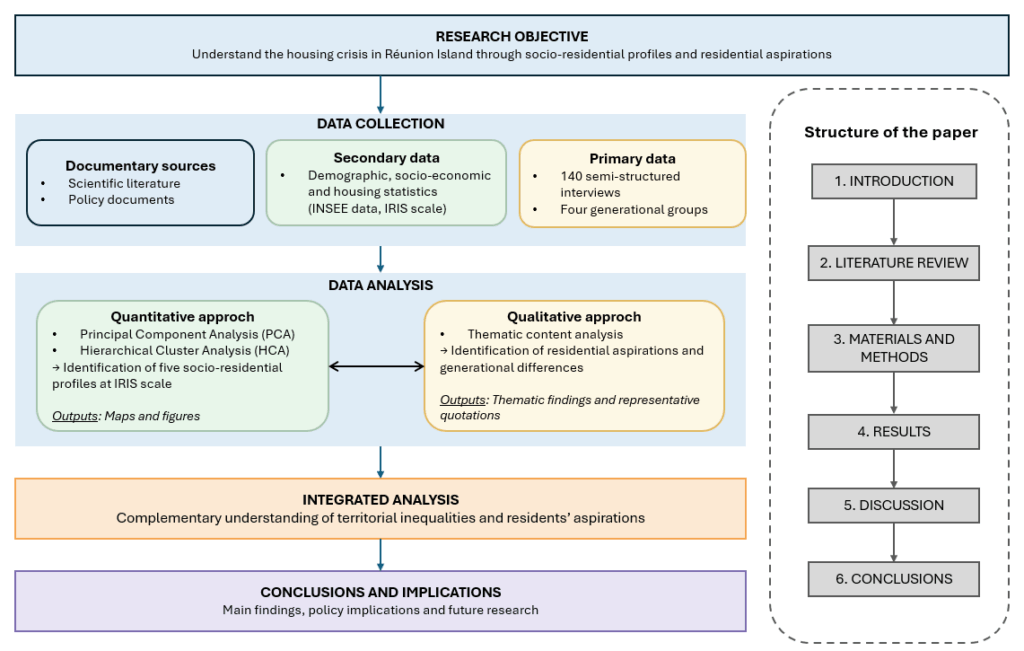
Source: By the authors
Figure 1: A schematic diagram simplifying the methods and structure
- Data synthesis: In this stage, the secondary and primary data and the results of quantitative and qualitative analyses were compiled/integrated to identify recurring themes, residential imaginaries, and intergenerational differences in residential aspirations, deriving specific conclusions, implications, and recommendations to deal with the examined situation.
- Data presentation: The quantitative results are presented through maps and figures illustrating the socio-residential profiles identified by the PCA and cluster analysis. The qualitative findings are presented through thematic analyses supported by representative quotations from interview participants, providing insight into how residents experience, interpret, and articulate their residential aspirations.
2. Literature Review
This section reviews the main theoretical concepts underpinning the study. It first examines the literature on housing insecurity before discussing residential aspirations and the concept of the aspirations gap. The section concludes by identifying the knowledge gap addressed by this research.
2.1. Housing insecurity
Housing is a dwelling unit that enables an individual to take shelter while carrying out activities necessary for their physical and psychological wellbeing. It also contributes to individual autonomy and social identity [6] as well as the development of a place attachment, or an emotional connection to one’s home [7]. Yet for many households worldwide, access to adequate housing remains deeply unequal. Housing insecurity encompasses multiple interrelated dimensions that resist standardisation into a single definition. In Anglo-Saxon frameworks, it is primarily approached through technical and behavioural standards. The National Center for Healthy Housing, for instance, formulates a series of recommendations aimed at ensuring a safe and healthy living environment, particularly regarding maintenance practices, appropriate occupant behaviors, and the need for accessible and affordable housing [8].
Housing insecurity is nonetheless commonly characterized by four overlapping dimensions: the unaffordability of housing costs relative to household income; compromised safety and health resulting from substandard conditions, overcrowding, exposure to environmental hazards, and neighbourhood quality; residential instability, including reliance on emergency shelters, temporary accommodations, or episodes of homelessness; and tenure insecurity, marked by limited legal protections against eviction and involuntary displacement [9].
Notably, among these factors, housing quality receives comparatively less attention than affordability, partly because it is perceived as a less prevalent and less pressing issue, particularly in the United States. In France, however, housing quality is considered a major factor. The Fondation pour le Logement des Défavorisés defines mal-logement, the French concept of housing insecurity, more broadly than Anglo-Saxon approaches, encompassing not only the absence of personal housing and difficulties in accessing or maintaining it, but also barriers in residential pathways and the qualitative deficit of the built environment leading to a lack of comfort for occupants [1]. This broader, socially situated conception of housing insecurity is particularly relevant in the context of Réunion Island, as the following sections illustrate.
Housing insecurity is deeply connected to monetary poverty. In the European Union, a person is considered to be living in monetary poverty if their disposable income (after tax and social benefits) is less than 60% of the median income [10]. This connection operates through multiple channels. Gender, employment status, level of education, socio-professional category, and type and duration of employment contract all shape income levels and, consequently, housing access. Paradoxically, many workers are employed yet still earn insufficient income. Workers in certain sectors (agriculture, personal services, food, etc.) are experiencing job insecurity, mainly due to seasonality and the proportion of part-time contracts, which result in low incomes [11].
Poverty can also manifest itself in more unexpected contexts, such as asset-rich but income-poor homeowners, or even individuals in higher socio-professional categories who fall below the poverty line [12]. These dynamics are particularly pronounced in overseas territories such as Réunion Island, where structural economic dependence and a high cost of living combine to amplify the gap between income levels and housing costs. Other studies have shown that certain population groups are more exposed to housing insecurity. Young adults exhibiting disruptive behaviors or experiencing difficulties in their educational trajectories may be more exposed to housing insecurity [13]. Furthermore, advancing age, ethnic background, and the presence of a disability are factors that increase vulnerability [14].
Housing insecurity has numerous and significant consequences that affect various aspects of individuals’ lives. Inadequate housing can increase the risk factors of developing physical diseases like cancer or cardiovascular diseases [15], but also mental health disorders, particularly those associated with social isolation and chronic stress. Children are also affected by housing insecurity, which undermines their living conditions and healthy development [16]. Housing instability can also undermine employment stability, particularly among mothers with limited flexibility in managing their working hours [17]. Critically, housing precarity limits individuals’ ability to pursue their residential aspirations, constraining not only what households can access, but what they allow themselves to imagine.
2.2. Residential aspirations
Living in a given place or in a specific type of home can be the result of several determining factors: a choice, a constraint, or a taken-for-granted condition. Individuals can deliberately ground their residential choices in individual preferences, strategies for wealth accumulation, or affective attachments. For others, residential location may be an obligation imposed by authorities through rehousing policies or a form of economic insecurity, such as expulsion, eviction, or family breakdown. Other residential patterns are inherited and renewed, forming a tacit continuity where living conditions are shaped by ingrained habits that are no longer questioned. Understanding residential aspirations therefore requires moving beyond rational choice frameworks, which tend to conceptualize housing decisions as the outcome of preferences and constraints, towards a broader conception that accounts for the social, cultural, and generational dimensions of what households desire from their housing[4].
Empirical research across different national contexts illustrates how residential aspirations are simultaneously shaped by social dispositions, life-course trajectories, and structural constraints. A study conducted among middle-class households in Switzerland shows that while income determines material access to housing, it plays a secondary role compared to residential preferences shaped by lifestyle. These preferences reflect differentiated relationships to dwelling: some households value tradition or family stability, while others seek environments perceived as safe, quiet, sociable, or stimulating. Housing choices thus appear to be shaped as much by social dispositions as by cultural and emotional aspirations [18].
By contrast, for social housing tenants, who often face economic insecurity, the possibilities for residential mobility are slimmer. While their residential aspirations change with the stages of their lives, these aspirations are thwarted by a lack of financial means [19]. Other studies have shown that gender, age, marital status, and life trajectories strongly shape residential pathways. For example, some retired women living alone view mobility as an opportunity to redefine their living environment and assert a new autonomy, while others, more affected by insecurity and deteriorating living conditions, are forced to move, which is no longer a choice [20].
Taken together, these studies suggest that residential aspirations are not simply individual preferences but are socially and structurally situated, and that the gap between what households aspire to and what they can realistically access tends to widen under conditions of economic constraint. This phenomenon was conceptualised by Crawford and McKee [5] as an “aspirational lag”: a structural delay between inherited aspirational norms, shaped by previous generations’ housing experiences and the material conditions that would make those aspirations attainable, a dynamic that is particularly acute among younger generations facing transformed housing markets.
Despite growing research interest in residential aspirations, island and overseas territories remain underrepresented in this literature. Yet these territories present distinctive configurations that make the study of residential aspirations particularly relevant: deeply rooted cultural traditions of dwelling, and socio-economic, geographical, and climatic contexts that diverge significantly from metropolitan norms.
In such contexts, the mismatch between aspirations and accessible housing forms does not only produce material dissatisfaction, it also shapes residents’ attitudes towards housing projects and construction methods. When proposed housing forms fail to resonate with local residential cultures and aspirations, they are more likely to face resistance and limited social acceptability among residents [21], [22]. Understanding residential aspirations in these contexts therefore requires attending to their cultural and territorial specificity, which is what this paper seeks to do in the case of Réunion Island.
Methodology:
This section describes the methodological framework adopted in the study. It presents the study area, the quantitative and qualitative data sources, the analytical methods employed, and the procedures used to analyse and interpret the data.
3.1. The case study: Réunion Island
Réunion Island, located in the southern Indian Ocean, is a former French colony that became an overseas department in 1946 (Figure 2). As a tropical island territory, it faces numerous socio-economic challenges. It is exposed to significant climatic risks, making it vulnerable in many respects, particularly in terms of housing and infrastructure. As a young department, Réunion has been involved in a policy of catching up with the rest of mainland France. While this policy aimed to equalize living conditions, it has often reinforced social and territorial inequalities, as the island lacks the necessary infrastructure to sustain this catch-up. The rapid tertiarization of the economy, without a real phase of industrialization, has contributed to the long-term entrenchment of specific forms of poverty and economic dependence [23]. The panorama of poverty on Réunion, produced by INSEE in 2023, ranks the island in third place among the poorest departments in France, with a poverty rate of 36%, more than 2.5 times higher than the national average of 14%. This is a sobering fact for an island of just over 896,000 inhabitants as of 2025 [24].
Housing in Réunion has undergone profound transformations. Early dwellings were designed for outdoor living. From the first settlement until the 1960s, life was primarily organised outdoors around straw huts, with farming, cooking, and domestic activities taking place in the surrounding space [25].
The introduction of corrugated iron improved resilience to cyclones, gradually transforming building practices. The Creole way of life traditionally revolved around three spaces: the front kour, the kaz, and the back kour [26]. The front kour is an ornamental garden, rich in flowers, linking the entrance gate (baro) to the kaz, typically via a central path [27]. The veranda at the entrance to the kaz serves as a transitional space before accessing the living areas (bedrooms and living room, in particular). The back kour is a more intimate space, generally reserved for family, where most domestic activities (cooking, farming, laundry) take place. From the straw huts of the early settlements to apartment blocks, housing became denser and transformed after Departmentalization.
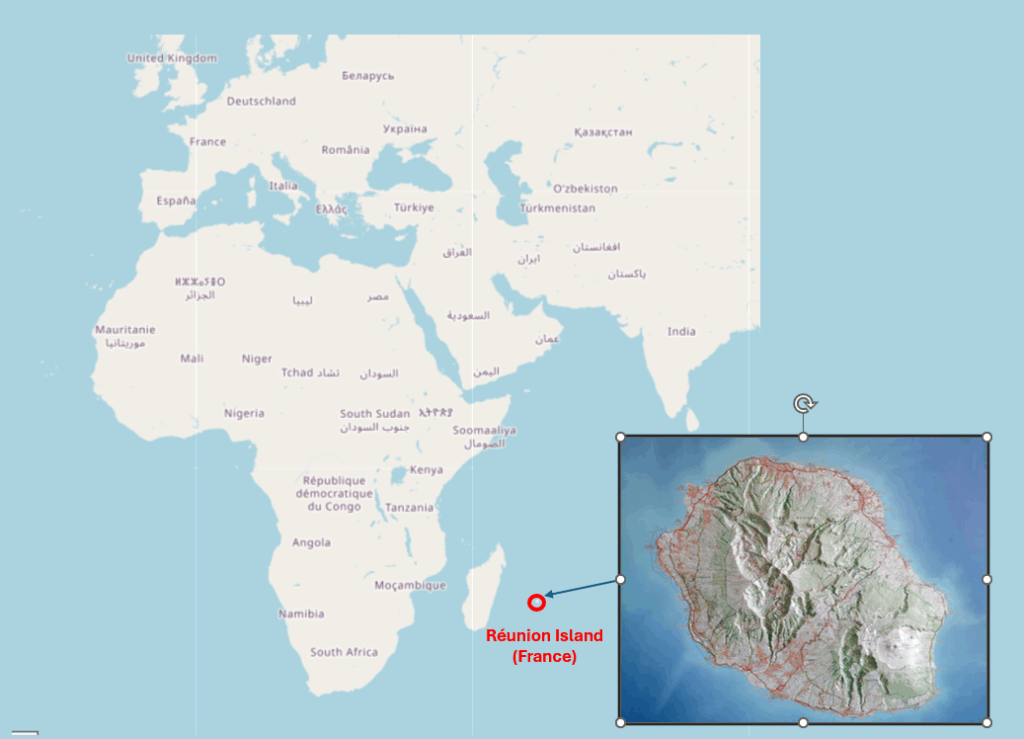
Source: OpenStreetMap and IGN
Figure 2: Location of Réunion Island in the southern Indian Ocean
The use of local materials (wood and plants) in the first building forms has given way to the massive use of concrete. Popular for its low cost, sanitary qualities, and industrial prefabrication possibilities, concrete led to the development of standardised and functional architecture, continuing the model of imported colonial housing [28]. In these so-called ”solid” homes, the kitchen and bathroom are integrated into the kaz, representing a significant change in living habits. At the same time, the rise of collective housing introduced another way of life: living in multi-story buildings, where gardens and, consequently, many outdoor activities, were no longer available. While some saw this as progress and expressed a desire to live there, others perceived the transition as a constraint, particularly during demolitions or housing rehabilitation programs[29].
Although part of the island’s heritage, the identity of the Creole kaz has gradually faded, replaced by new construction methods and changing intergenerational needs and aspirations. INSEE classifies housing in overseas territories into four categories. Makeshift dwellings are temporary or transitory structures, often constructed from wood and corrugated iron. Traditional wooden kaz can be expanded by successive extensions, sometimes even transformed into a solid form. Wooden houses or buildings are more closely related to traditional Creole dwellings or older constructions. Finally, solid houses and buildings are more recent constructions, mainly made of concrete and breeze blocks [30]. In 2021, according to INSEE data, 90.31% of principal residences were solid; however, there were still just over 1,600 makeshift dwellings in the area.
In addition, a significant proportion of Réunionese housing presents structural shortcomings: 0.58% of homes had no electricity, 7.74% had no hot water, and 1.92% still had bathrooms located outside the dwelling. Moreover, 8.79% of dwellings were too small to accommodate all household members under acceptable conditions. Finally, a large proportion of homes (45.89%) did not have a solar water heater, forcing households to rely on more expensive systems such as electric or gas water heaters.
The persistence of substandard housing reflects a housing crisis that has been firmly entrenched in Réunion for several decades. In the 1950s, almost 9% of Réunion’s population lived in shanty towns [26]. These pockets of makeshift housing, consisting mainly of wooden huts and straw huts, have gradually spread across the island. In response to this alarming situation, the government introduced several measures to improve housing conditions. The first social housing units were built to meet the challenges of population growth and precarity. The Debré law enabled the dismantling of traditional slums but did not eradicate substandard housing. By the mid-1970s, two-third of the island’s housing stock still required improvement or demolition [31]. Subsequent renovation programmes contributed to gradual improvements in comfort [32]. Between 2008 and 2016, substandard housing increased across most of the island’s municipalities, with only five recording a significant reduction [33]. All these assessments highlight the state of housing insecurity as defined by the Fondation pour le Logement des Défavorisés in Réunion Island. Its latest report [1] estimates that there will be just over 59,000 people without a personal home by the end of 2024 (including 2,694 homeless people and almost 53,000 people living in forced accommodation with a third party).
Additionally, access to housing is becoming increasingly challenging, with demand far outstripping supply. More than 49,000 applications for social housing had been made in the region, with waiting times getting ever longer (around 18 months). Many households are finding it difficult to stay in their homes, while others are encountering obstacles to their residential path. In addition to the fact that the supply of housing is insufficient to meet needs, many homes do not meet the minimum standards demanded by society; in particular, this is due to a lack of quality in the buildings, which affects hygrothermal and acoustic comfort. This entrenched housing crisis provides the territorial context within which the socio-spatial analysis and qualitative exploration of residential aspirations developed in this study are situated. To address the socio-spatial dynamics of housing insecurity and residential aspirations in Réunion Island, this study combines a quantitative and a qualitative methodological approach. The quantitative analysis aims to identify territorial configurations of housing insecurity and socio-economic inequalities, while the qualitative analysis explores how these structural conditions resonate with residents’ residential aspirations across generations.
3.2. Principal Component Analysis (PCA)
Housing insecurity results from the combination of multiple interrelated factors, including housing forms, income structures, household composition, and access to basic amenities. Capturing such multidimensional phenomena requires a method capable of analyzing correlations between variables simultaneously rather than isolating single effects. Principal Component Analysis (PCA) is therefore particularly suited to this research, as it allows the identification of underlying structures and dominant gradients shaping the dataset. In this framework, IRIS neighborhoods (aggregated units for statistical information) are used as the units of observation, enabling the identification and visualization of socio-spatial inequalities at a fine-grained territorial scale. PCA is a multivariate statistical technique commonly used to reduce the dimensionality of large datasets by transforming correlated quantitative variables into a smaller number of uncorrelated components [34], [35].
These principal components are linear combinations of the original variables and are ordered according to the amount of variance they explain, allowing the main structures and gradients in the data to be identified and interpreted. Before analysis, all variables were standardised (centred and scaled) to ensure comparability across variables expressed in different units or ranges. The number of retained axes was determined using Kaiser’s criterion, which recommends retaining components with eigenvalues greater than 1 [36], supported by visual inspection of the scree plot. Interpretation was supported by graphical tools such as correlation circles and factor maps, which provide a synthetic representation of relationships between variables and IRIS neighbourhoods [37].
To complement the PCA and move from continuous gradients to a more interpretable typology, a Hierarchical Clustering on Principal Components (HCPC) was performed on the retained principal axes using Ward’s agglomeration method and squared Euclidean distance, as implemented in the FactoMineR package in R [38]. This approach groups IRIS neighbourhoods into homogeneous clusters based on their overall socio-residential profiles rather than on isolated variables, providing a synthetic reading of territorial inequalities. The optimal number of clusters was initially suggested as four by the automatic partitioning criterion embedded in the HCPC procedure.
However, following comparative examination of several partitions, five clusters were retained on the grounds of superior socio-residential interpretability, each cluster displaying a more clearly differentiated and analytically meaningful profile. The resulting classification serves as the primary framework for interpreting housing insecurity patterns across the island. The PCA presented in this article is based on 28 variables grouped into six categories (Appendix A), selected to capture the economic, morphological, and social dimensions of housing insecurity.
- The first category covers property market values, based on median prices per square metre for both sales and rentals.
- The second captures the temporal dimension of the housing stock through the year of construction, covering several periods from before 1919 to 2018.
- The third describes housing forms, classified as makeshift dwellings, traditional kaz, wooden houses or buildings, and solid houses or buildings.
- The fourth group encompasses factors contributing to housing insecurity, including the absence of electricity, hot water, and indoor sanitary facilities, as well as overcrowding and the absence of solar water heaters.
- The fifth covers household composition, distinguishing single-person households, couples with or without children, and single-parent families.
- The sixth captures household income structure through deciles of disposable income, the interdecile ratio, the Gini index, and the respective shares of employment income and social benefits.
Most variables are drawn from the latest INSEE census (2021), published in 2024, which serves as the reference year for all analyses. Property market data, however, are available only at the municipal scale rather than the IRIS scale, owing to data availability constraints. While this introduces a degree of scalar heterogeneity into the analysis, the municipal scale remains the finest available for this type of data in France, and its inclusion is justified by the central role of land market dynamics in structuring territorial inequalities. The IRIS level has been chosen for its analytical precision. It is the finest neighbourhood-level scale available for socio-economic data in France. IRIS units are designed to represent relatively homogeneous residential contexts, making them particularly suitable for analysing intra-urban socio-spatial inequalities. Among the 344 IRIS identified in Réunion Island, 270 were included in the analysis. Excluded IRIS correspond to very sparsely populated areas, mainly located in the island’s interior and overlapping with the National Park perimeter, a protected space with limited residential occupation. To ensure comparability between neighbourhoods and to neutralize the effect of territorial size, all variables were expressed as proportions rather than absolute values.
Before the PCA, potential multicollinearity and redundancy among variables were examined through a correlation matrix. The analysis revealed several expected correlation structures: indicators of housing insecurity, including the absence of electricity, hot water, and indoor sanitary facilities, are strongly inter-correlated, reflecting their co-occurrence in the most precarious dwellings; traditional and wooden housing forms are positively correlated with each other and negatively correlated with solid construction; and income inequality measures, the interdecile ratio and the Gini index, show strong mutual correlation, as both capture distributional disparities in household income. Despite these correlations, all 28 variables were retained on the grounds of their distinct thematic contribution: each captures a specific and non-redundant dimension of the socio-residential profile of IRIS neighbourhoods, and their grouping into six analytical categories ensures conceptual coherence within each dimension.
3.3. Thematic Content Analysis
Residential aspirations in Réunion are examined here through a thematic content analysis of semi-structured interview data [39]. This approach was chosen for its ability to capture the complexity and diversity of residents’ representations of housing across generations, while remaining attentive to both the frequency of recurring themes and their contextual meaning within individual narratives.
Data were collected through 140 semi-structured interviews conducted by telephone, covering four age groups: senior citizens (60-87 years, n=19), adults (22-59 years, n=63), young adults (16-21 years, n=23), and children (6-15 years, n=35). Interview guides were specifically designed for each age group to ensure age-appropriate questions while maintaining thematic consistency across the corpus. Semi-structured interviews were chosen to allow participants freedom of expression while ensuring adherence to the research themes. All interviews were conducted in French, fully transcribed, and constitute the primary corpus for analysis. Data collection continued until thematic saturation was reached, the point at which new interviews no longer generated additional themes or substantively modified existing ones [40].
The analysis followed a two-stage procedure. In the first stage, dominant terms and expressions were identified within each age group through frequency-based analysis, visualised using word clouds. These visualisations served as an exploratory tool to map the lexical landscape of residential aspirations for each generational group. Word clouds were used solely as an exploratory visualisation tool to map lexical patterns and support the coding process, but they do not constitute the analytical basis of the qualitative interpretation, which relies on thematic analysis of interview transcripts. In the second stage, recurring terms and expressions were grouped into thematic categories through close reading of the transcripts, following an inductive thematic analysis approach, whereby themes are derived from the data rather than imposed from a prior theoretical framework [39]. This process led to the identification of three to four themes per age group, each capturing a distinct dimension of residential aspirations as expressed by participants. Themes were defined and named on the basis of their internal coherence and their analytical relevance to the research question. Interview excerpts are provided throughout the results section to ground each theme in participants’ own words.
Ethical considerations: The interviews were conducted in accordance with established ethical principles for qualitative research in the social sciences. Before each interview, participants were informed about the objectives of the study, the voluntary nature of their participation, and their right to withdraw at any time. Informed consent was obtained verbally before each telephone interview, and anonymity and confidentiality were ensured throughout the research process.
Results:
4.1. Housing and Precarity: A Cross-Reading of Territorial Inequalities
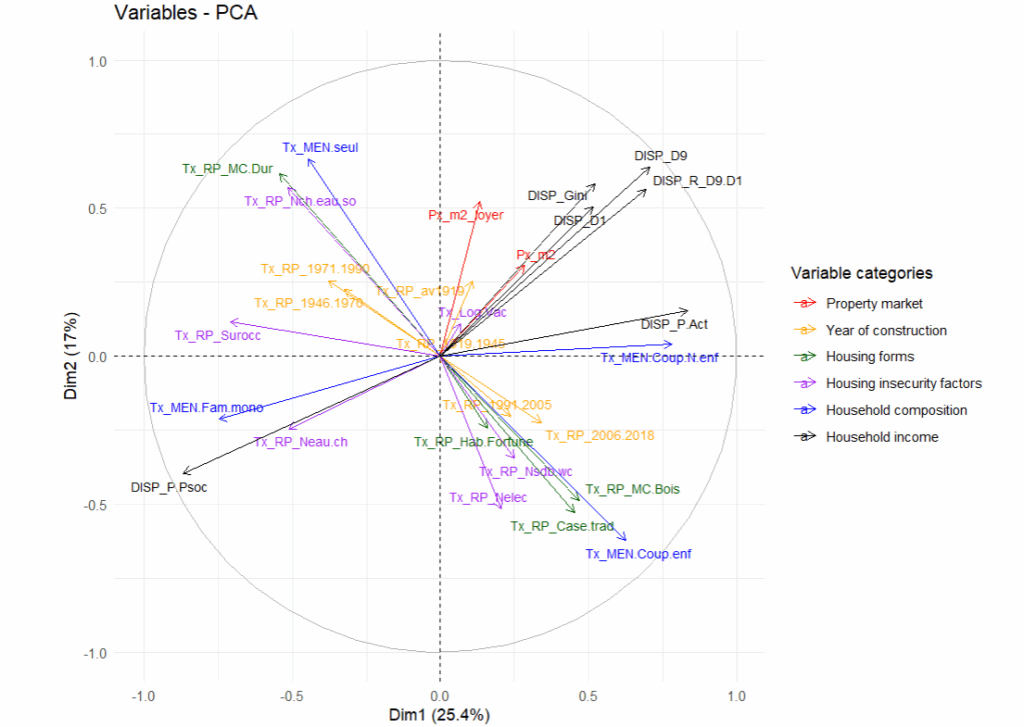
Figure 3 presents the correlation circle associated with the PCA, illustrating the relationships between the 28 variables across the six analytical categories. The first two components account for slightly more than 40% of the variance. Although the explained variance remains moderate, this level is common in analyses of heterogeneous socio-economic and residential data at a fine spatial scale, where the complexity of the phenomena studied necessarily distributes variance across a larger number of components. More importantly for the purposes of this analysis, the first two components capture clear and interpretable socio-spatial gradients, which are central to the analysis of territorial inequalities and housing precarity across Réunion Island.
The first component highlights a clear contrast between two socio-economic profiles. On the positive side of Axis 1 are areas where households derive most of their income from professional activities. Conversely, on the negative side are areas with a high dependency on social benefits, a high proportion of single-parent families, and indicators of inadequate housing conditions (overcrowding, lack of hot water). This opposition, reflected in the opposing vectors and inverse correlations on Axis 1, illustrates a socioeconomic gradient. Areas at the positive end of Axis 1 are generally better integrated into the economic fabric and tend to be associated with higher levels of infrastructure and access to employment opportunities. In contrast, neighbourhoods at the negative end are characterized by precarious income, fragile family structures, and substandard housing. The chronology of housing construction also reinforces this opposition: older dwellings (built before 1970) are closely associated with precarious housing conditions, while more recent constructions (post-1990) are correlated with more formal, solid housing and higher property values. However, the vectors associated with construction period variables are relatively short, indicating a weak contribution to the explained variance on this axis; this temporal interpretation should therefore be treated with caution.
Source: By the authors
Note: The full names and descriptions of the 28 variables included in the Principal Component Analysis are provided in Appendix A.
Figure 3: Correlation circle associated with the PCA
The second component primarily distinguishes areas based on the nature of residential buildings and associated comfort levels. Variables describing property values, solid construction methods, and single-person households are positively associated with Axis 2. This indicates that in the upper part of the graph, residential areas tend to have more formal housing structures (solid construction) where standardized housing predominates. Conversely, variables representing traditional kaz, makeshift dwellings, or other indicators of housing insecurity (such as a lack of electricity or an indoor shower room) are negatively associated with this axis.
These results suggest residential configurations that are less formal or more dilapidated, which may partly reflect self-build practices or older construction forms. They also indicate that traditional kaz are more frequently associated with substandard housing conditions, particularly when assessed against contemporary regulatory standards. While the separation of uses was common in traditional Réunionese housing, the current national regulatory framework tends to classify specific configurations, such as the absence of an indoor shower room, as indicators of housing precarity, as they do not meet present-day requirements in terms of comfort, hygiene, and safety. This axis thus reveals a hierarchy of residential comfort, structuring space according to the quality of buildings and the availability of basic amenities. It should be noted that the orthogonality between the ”solid structures” and ”high income” vectors (9th decile of disposable income) indicates that there is no systematic link between structural comfort and wealth. In other words, solid construction methods are not exclusively associated with wealthier households. This reflects both the widespread use of concrete in Réunion’s built environment and the diversity of social situations within residential morphologies.
Finally, the hierarchical cluster analysis applied to the retained principal components identifies five types of neighbourhoods with distinct socio-residential profiles. Beyond highlighting social inequalities, this classification reveals spatially differentiated configurations, where housing conditions, income structures, and land market dynamics interact in contrasted ways across the island (Figure 4).
Cluster 1 comprises 45 neighbourhoods distributed across 10 of the island’s 24 municipalities. These neighbourhoods are characterized by relatively low and homogeneous household incomes, often associated with the island’s early social housing policies. The mean first income decile is approximately €8,422, compared with €9,013 across the island, while the mean ninth decile reaches €27,192, well below the island-wide average of €36,517. These neighbourhoods are also characterised by high reliance on social benefits (an average of 30% of household disposable income in these neighbourhoods, compared with 18% across the island) and an over-representation of single-parent families; these areas still exhibit forms of housing inadequacy despite the predominance of solid construction. Most dwellings were built between 1946 and 1990 and frequently lack basic amenities such as hot water. The prevalence of overcrowded housing reflects both the age of the housing stock and significant demographic changes, resulting in a growing mismatch between inherited dwelling sizes and current household structures. This configuration highlights a form of functional misalignment between the characteristics of an ageing housing stock and contemporary residential needs.
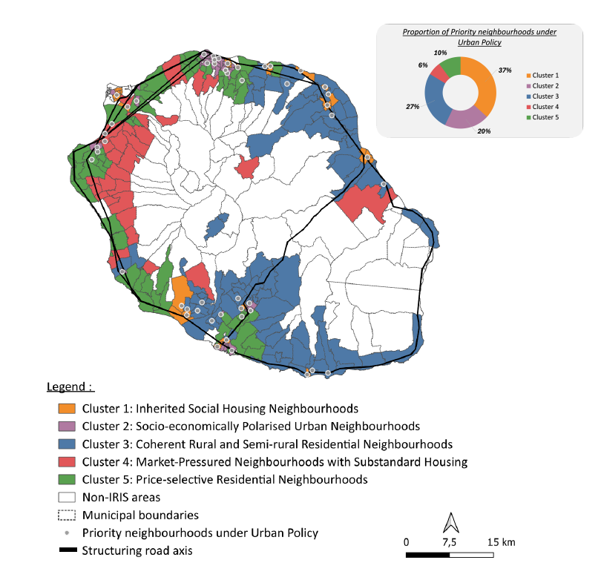
Source: By the authors
Figure 4: Mapping residential inequalities in Réunion Island
Cluster 2 comprises 44 areas across seven different municipalities, primarily located in dense urban centers. These areas are characterized by a high Gini index (0.338, compared with an island-wide average of 0.314), reflecting strong internal income inequalities. They combine high property prices with limited residential comfort, alongside the coexistence of housing vacancy and overcrowding. This configuration reflects a dense urban fabric marked by the superposition of contrasting residential trajectories, where social housing, private rental units, and market-oriented developments coexist within the same neighbourhoods. The high proportion of single-person households further points to fragmented residential pathways, often shaped by constraints related to affordability, availability, and housing quality. Rather than a uniform socio-residential profile, these neighbourhoods are characterized by internal heterogeneity and weak residential coherence
Cluster 3 is the most socio-economically homogeneous profile, comprising 91 areas across 15 municipalities. Household incomes are average but relatively homogeneous and are mainly derived from employment. These neighbourhoods are predominantly inhabited by couples, with or without children, and property prices remain comparatively low (€1,956/m² compared with the island-wide average of €2,414/m²). A high proportion of wooden houses and traditional kaz reflects the predominance of individual housing forms. Dwellings are generally adequately sized and equipped with solar water heaters, suggesting residential conditions that are broadly consistent with household needs. Spatially, these neighbourhoods are mainly located in the southern highlands, as well as along the south-eastern and eastern coasts of the island and are associated with a predominantly rural or semi-rural residential context. The growing share of principal residences built between 1990 and 2018 points to ongoing densification processes. While these areas currently display a relatively coherent socio-residential configuration, this situation appears closely associated with lower land pressure and may therefore be sensitive to future changes in residential attractiveness and housing demand.
Cluster 4 comprises 32 neighbourhoods characterised by a high proportion of principal residences in severely precarious conditions, including the absence of electricity, hot water, or indoor sanitary facilities. Makeshift dwellings and traditional kaz are more prevalent than elsewhere, and most buildings were constructed between 1919 and 1945, before Departmentalisation and the widespread use of concrete. Households with children are over-represented, while household incomes remain relatively low. Despite these conditions, these neighbourhoods are subject to strong land and property pressure, reflected in high property prices per square metre (€3,183/m² compared with the island-wide average of €2,414/m²), without any corresponding improvement in the quality of the built environment. Spatially, these neighbourhoods are mainly located in the mid-slope areas of the western part of the island, one of the most attractive regions in terms of residential quality of life, and to a lesser extent in parts of the north, south, and east. This configuration highlights a pronounced spatial tension between territorial attractiveness and housing conditions, where old and precarious residential fabrics persist within areas experiencing strong market dynamics.
Lastly, Cluster 5 comprises 58 IRIS across 9 municipalities. Household incomes in these neighbourhoods are particularly high, with a first income decile of €10,293 (compared with the island-wide average of €9,013) and a ninth income decile of €47,969 (compared with €36,517 island-wide), primarily derived from employment. There is a high proportion of couples, especially those without children, as well as single-person households, to a lesser extent. Solid construction predominates. These dwellings are well-equipped, with solar water heaters and no signs of overcrowding. Property prices are very high, the highest on the island. This cluster corresponds to the areas with the highest income levels (the West Coast, the South-West, and the North-West), characterized by highly comfortable individual housing accessible only to a limited segment of the population. This cluster embodies a form of social exclusivity, reflecting exclusion through price and reinforcing socio-spatial segregation.
The distribution of priority neighbourhoods under urban policy (QPV) across clusters reveals a strong concentration in clusters 1 and 3, which account for 37% and 27% of QPV, respectively. QPV are thus primarily associated, on the one hand, with inherited social housing neighbourhoods and, on the other hand, with fragile rural and semi-rural areas, highlighting the diversity of residential vulnerability across Réunion Island. Cluster 2, characterized by strong socio-economic polarization, concentrates 20% of QPV, while their presence remains marginal in clusters 4 and 5 (respectively 6% and 10%). When present in cluster 4, QPV are mainly located in the western part of the island, in close proximity to recently developed major transport corridors, particularly along the Route des Tamarins, completed in 2009, suggesting forms of residential vulnerability linked to accessibility effects and infrastructure-induced land market pressures. It should be noted that cluster 5 also includes a small number of neighbourhoods classified as priority urban areas (QPV), such as Savannah, L’Eperon and Fleurimont in Saint-Paul, Domenjod in Saint-Denis, and Condé Concession in Saint-Pierre. Their inclusion reflects the fact that, at the IRIS scale, these areas are embedded within high-value residential environments, highlighting the coexistence of socially contrasted housing situations within territories characterised by strong market selectivity.
The quantitative results highlight strong territorial inequalities and contrasted socio-residential profiles across Réunion Island, identifying where housing insecurity is concentrated and how it is spatially structured. The qualitative analysis presented in the following section approaches the same object from a complementary angle, exploring how residents from different age groups perceive and articulate their residential aspirations. Together, these two analytical strands provide a more complete picture of the housing situation in Réunion Island than either approach could offer alone.
4.2. Generational Perspectives on the Ideal Kaz:
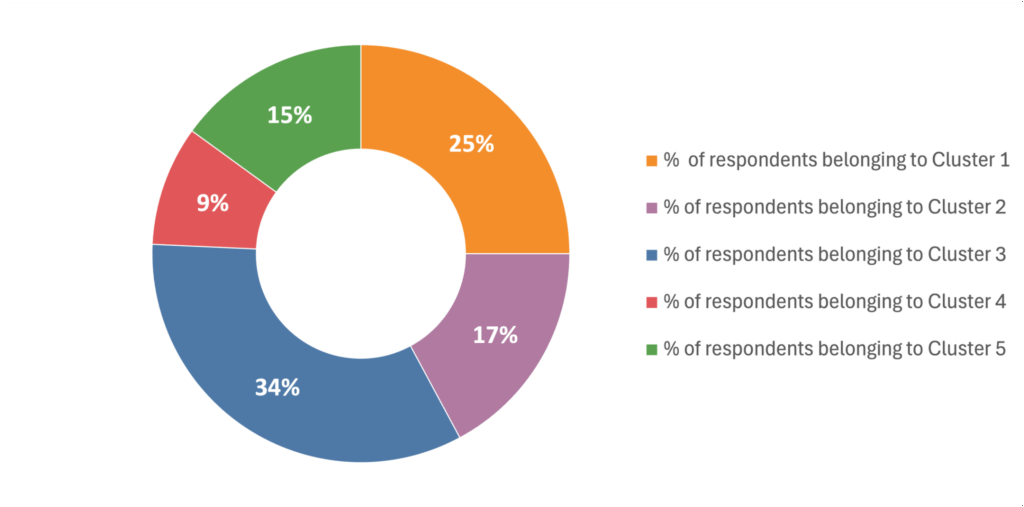
Territorial analysis reveals markedly contrasted socio-residential configurations across Réunion Island, highlighting spatially differentiated forms of housing precarity, coherence, and market pressure. To address this limitation, this section adopts a qualitative perspective focused on residential aspirations, with particular attention to intergenerational differences in representations of the ideal kaz. Examining how individuals from different age groups articulate their housing ideals makes it possible to explore the social resonance of the territorial configurations identified earlier, and to assess the extent to which these residential forms align or fail to align with residents’ expectations and life trajectories. Figure 5 presents the distribution of survey respondents across the five socio-residential clusters, providing a contextual basis for interpreting the qualitative results that follow.
Source: By the authors
Figure 5: Proportion of respondents by cluster
4.2.1. Senior citizens
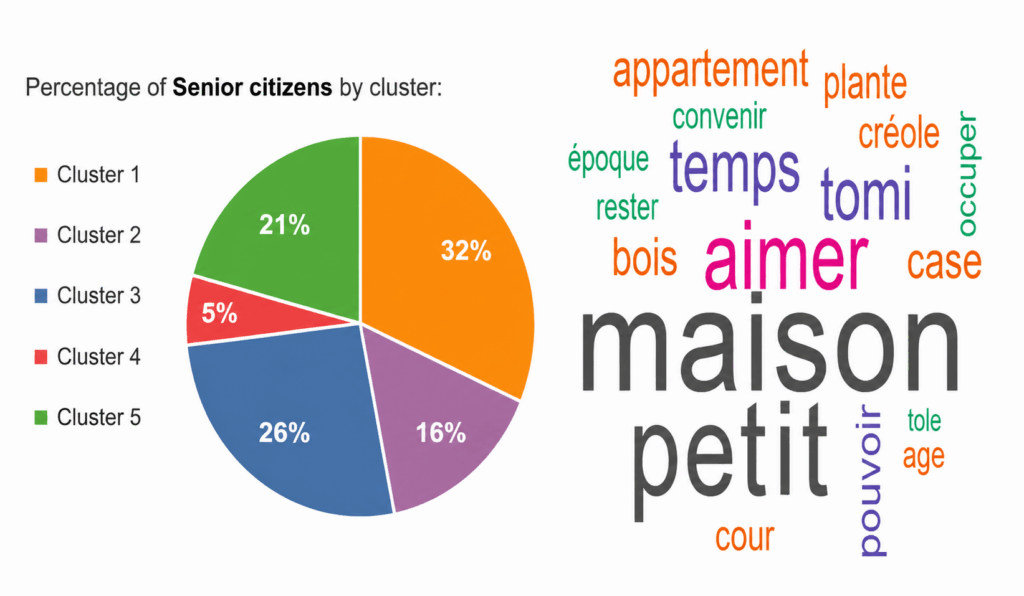
Among the seniors surveyed (Figure 6), the ideal kaz is predominantly perceived as a small (petit) house (maison). The term ”petit” refers not only to a modest or compact dwelling, but also conveys warmth and reassurance. This aspiration is often expressed in terms of regret or unfulfilled wishes: ”love” (aimer) here refers to an unfulfilled aspiration or wish, since many never obtained the cherished small house, such as the ”Tomi” kaz of earlier times (époque). As one participant described her ideal home: “A small house, a kaz with a corrugated iron roof, a garden to grow things, space for animals” (“Une petite maison, une kaz avec de la tôle, un jardin pour planter des choses, de la place pour les animaux”, Entretien n°66). References to the kaz Tomi, a form of individual housing with a wooden structure (bois) and a corrugated iron (tole) roof, which was very successful in the 1960s due to its traditional architecture, reflect this nostalgia. For the seniors interviewed, the ideal kaz is inseparable from a garden (cour), where they can garden, grow various plants including medicinal herbs (zerbaz), and be in contact with nature. While some have been able to realize their dreams or are in a situation that suits them, others have been confronted with several constraints, like a lack of financial means. Financial constraints have forced compromises that are often experienced as resignation rather than choice: “Having more comfort would have been better, but you need the money, the credit and all that, you make do with what you have” (“Avoir du confort aurait été mieux mais il faut les sous, pour le crédit et tout, mais on fait avec ce qu’on a”, Entretien n°62). Moreover, the realities of ageing have pushed some to accept housing, often apartments, that they would not have chosen freely. It can be supposed that physical ageing makes it difficult to maintain individual housing.
When considered alongside the spatial distribution of senior citizens across residential clusters, these qualitative findings help to interpret the observed patterns. Seniors are unevenly distributed across the territory, with a marked concentration in inherited social housing neighbourhoods (Cluster 1, 32%) and in coherent rural and semi-rural residential areas (Cluster 3, 26%), while they are almost absent from neighbourhoods characterized by strong land pressure and severely substandard housing conditions (Cluster 4, 5%). A substantial share of the seniors surveyed live in Cluster 1, where the housing stock is predominantly collective and often organized in apartment buildings. In such configurations, access to individual housing has historically been limited, which largely explains why the residential ideal is so frequently framed through regret and unfulfilled aspiration. The gap between the dwelling occupied and the desired kaz is therefore not merely symbolic, but rooted in long-term, structurally constrained residential trajectories.
The traditional Réunionese family model, based on intergenerational cohabitation, where parents and children, even when they became adults, lived together or nearby, has evolved towards geographical distancing between generations. This weakens traditional forms of mutual assistance. For example, children are less able to take care of their parents’ gardens. This highlights the challenge of adapting housing for an ageing population, ensuring comfort, accessibility, and connection to the living environment. These results highlight a differentiated geography of ageing, structured by the interplay between inherited housing forms, market dynamics and evolving residential aspirations. These findings underscore the growing challenge of adapting housing stock and housing policies to an ageing population while preserving residents’ attachment to place, outdoor space, and the living environment.
 Source: By the authors
Figure 6: Original word cloud reflecting the aspirations of senior citizens
4.2.2. Adults
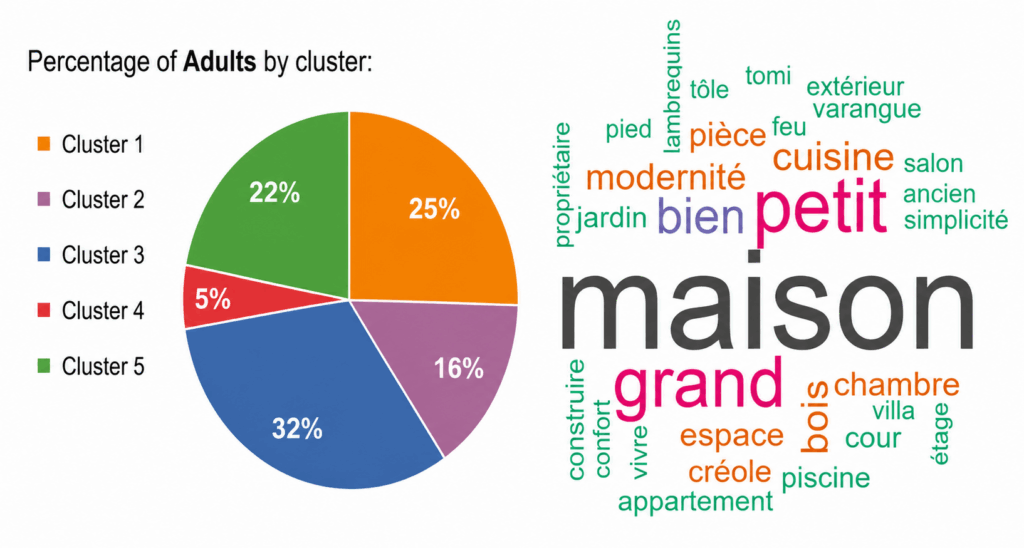
The ideal home for adults can be distinguished according to two main aspirations (Figure 7). The first, which is the most prominent, is the dream of living in a house (maison). The size of the house varies according to each person’s lifestyle and sensibilities. Adults who prefer a small (petit) house are attached to older (ancien) and more traditional Creole architecture, such as kaz Tomi. They value a simple yet comfortable lifestyle. Others, on the contrary, dream of a large (grand) villa built of solid materials, often with multiple storeys (étages). While some aspire to very modern architecture, with large spaces and an outdoor swimming pool, others want to combine tradition and modernity by retaining elements of traditional architecture. As one participant expressed: “I would like to have a modern house, but with Réunionese tradition, with lambrequins, if I can add wooden cladding I would […] keeping the old spirit but modernised” (“J’aimerais avoir une maison moderne, mais avec la tradition Réunionnaise, avec des lambrequins, si par exemple je peux mettre du bardage j’en mettrais […] garder l’esprit ancien mais modernisé”, Entretien n°1).
These diversified aspirations resonate with the spatial distribution of adults across residential clusters. Adults are mainly concentrated in coherent rural and semi-rural residential neighbourhoods (Cluster 3, 32%) and in inherited social housing neighbourhoods (Cluster 1, 25%), while a substantial share is also found in price-selective residential neighbourhoods (Cluster 5, 22%). This distribution reflects differentiated residential trajectories, ranging from constrained pathways within collective or modest housing environments to more selective trajectories allowing the realization of larger and more modern residential projects. Furthermore, regardless of the size of their house, these adults want a veranda and a garden (jardin) to enjoy the outdoors, fresh air, and wood-fired cooking (cuisine extérieure), which is an integral part of Réunionese culture. This attachment to outdoor space is expressed consistently across the corpus: “A wooden house, with the exterior decorated in wood […] with the outdoor kitchen, and the garden” (“Une case en bois, avec l’extérieur décoré de bois […] avec la cuisine à l’extérieur, et le jardin”,Entretien n°44). Although European norms and standards constrain the traditional separation of uses, specific features, such as the outdoor kitchen, remain and now complement contemporary construction practices. These elements highlight the persistence of culturally embedded ways of living within increasingly standardized housing forms.
The second aspiration among adults is to live in an ”apartment” (appartement), which is not always imposed but also represents a conscious choice for a group of adults who have adapted to this more European lifestyle. This aspiration is consistent with the presence of adults in socio-economically polarized urban neighbourhoods (Cluster 2, 16%), where collective housing is more prevalent.
There is also a widespread aspiration: to be a homeowner (propriétaire). Homeownership is a central concern for these adults, both as a personal life project and as a means of passing on a legacy, as one participant clearly expressed: “I picture a simple house, a small house with the bare essentials, as long as I am the owner and can leave something for my children” (“Je vois une maison simple, une petite maison avec le strict nécessaire pourvu que je sois propriétaire et que je puisse laisser quelque chose pour mes enfants”, Entretien n°32). The residential ideal is therefore at the intersection of experience, available resources, and intergenerational projections. This configuration reflects the “aspirational gap” [5] whereby the aspiration to homeownership persists across generations even as structural conditions make it increasingly difficult to achieve.
 Source: By the authors
Figure 7: Original word cloud reflecting the aspirations of adults
4.2.3. Young adults
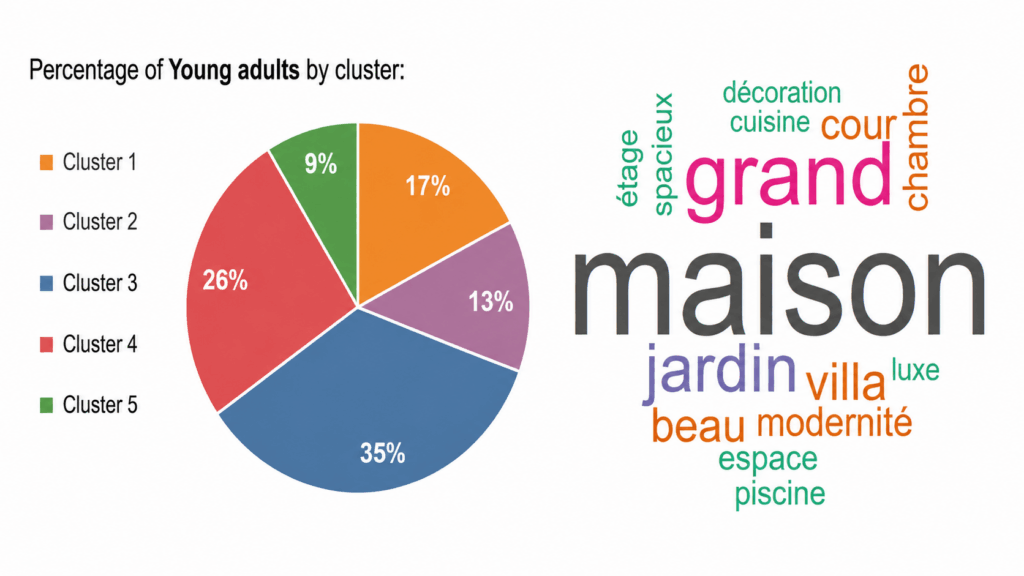
Young adults’ residential aspirations correspond to large (grand) houses, similar to very modern and luxurious villas, with several storeys (étage), particularly inspired by social media (Figure 8). They also expect spacious areas, with numerous large bedrooms (chambre) and an open-plan American-style kitchen (cuisine). As one participant expressed: “I would like my house to be modern with very architectural features, different heights and shapes that stand out” (“J’aimerais que ma maison soit moderne avec des démonstrations très architecturales, différentes hauteurs et des formes qui ressortent”, Entretien n°5). The thematic analysis highlights a residential ideal centered on visual impact, comfort and contemporary design. These aspirations must be interpreted in light of the spatial distribution of young adults across residential clusters. Young adults are primarily concentrated in coherent rural and semi-rural residential neighbourhoods (Cluster 3, 35%) and in market-pressured neighbourhoods with substandard housing (Cluster 4, 26%), while their presence in price-selective residential neighbourhoods (Cluster 5, 9%) remains limited. This distribution reveals a strong tension between highly ambitious residential ideals and more constrained housing conditions, particularly for young adults living in precarious or transitional residential environments.
The influence of globalised models is particularly visible in the spatial and functional organisation of the ideal home. One participant described his dream home as follows: “I picture myself with a courtyard surrounding the whole house, a flat roof, at least three or four bedrooms, an American-style kitchen, a spacious living room for movie nights, and a spa-style bathroom” (“Je me verrais bien avec une cour qui entoure toute la maison, un toit plat, au moins trois ou quatre chambres, une cuisine américaine, un salon spacieux pour les soirées cinéma et une salle de bain type spa”, Entretien n°35). These references are cultural markers imported from globalised media and digital platforms, reflecting a reconfiguration of residential aspirations where global influences are reshaping local housing standards. This reconfiguration does not entail a complete rejection of tradition, but rather an ambivalent relationship with it. As one young adult put it: “A more modern house, one that lives in its time : the past is fine but staying too stuck in it is not great” (“Une maison plus moderne, qui vit dans son temps, le passé c’est bien mais rester trop dedans ce n’est pas génial”, Entretien n°57). Housing is not rooted in a heritage-based approach but rather in a quest for social visibility and contemporary comfort, a quest reinforced by digital imaginaries and social media, which contribute to standardising aspirational housing models and amplifying expectations that are only partially achievable within current local housing markets.
There is also a desire for a garden (jardin), but this time one that serves primarily aesthetic function, featuring a swimming pool, reminiscent of the ornamental gardens of traditional houses, albeit reinterpreted for today. Unlike the functional and productive outdoor spaces valued by seniors, the garden here becomes a space of display and leisure, closely associated with contemporary lifestyles and visual representations.
Taken together, these findings suggest that young adults’ residential aspirations are characterized by a strong projection towards modernity, space, and status, combined with a limited capacity to access housing that corresponds to these ideals. This generational configuration highlights a growing mismatch between aspirations and residential opportunities, contributing to a differentiated geography of housing expectations and constraints across Réunion Island.
 Source: By the authors
Figure 8: Original word cloud reflecting the aspirations of young adults
4.2.4. Children
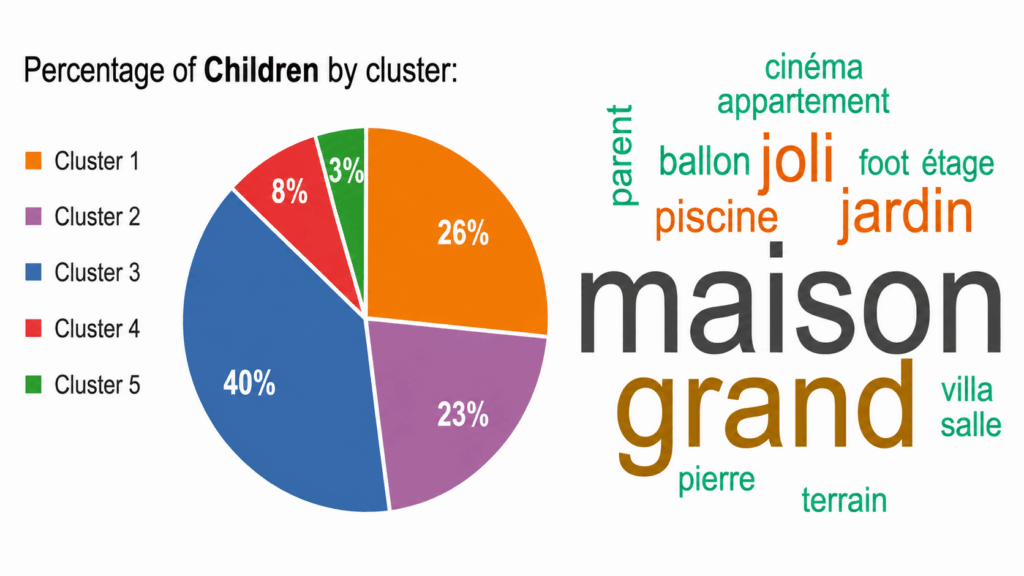
Children’s residential aspirations tend toward big (grand) and pretty (joli) houses with a garden (jardin) that are suited to their leisure activities, such as soccer field (terrain de foot), swimming pool (piscine), or even movie theater (cinema). As one child described his ideal home: “A big house with a garden, football goals, dark blue with a bit of red, and a balcony” (“Une grande maison avec un jardin, et des buts de foot, un bleu foncé avec un peu de rouge et avec un balcon”, Entretien n°84). The thematic analysis highlights an ideal home conceived primarily as a space for leisure, enjoyment, and imagination. One child simply stated: “I would like a room for making music and a cinema room in my house” (“J’aimerais avoir une salle pour faire de la musique, et avoir une salle de cinéma dans ma maison”, Entretien n°90). These aspirations, centred on play, creativity, and entertainment, reflect a conception of housing as a space of freedom and imagination rather than a functional or economic asset.
Beyond leisure, children consistently place the family unit at the centre of their residential ideal. The dream home is not imagined as an individual project but as a shared space of everyday life and intergenerational cohabitation. As one participant expressed: “If I have the means, I would need a house big enough for me and my parents” (“Si j’ai les moyens plus il me faudrait une maison assez pour moi et mes parents”, Entretien n°99). Ideally built of stone (pierre) and featuring an upper floor (étage), the ideal home is conceived as a space of connection, stability, and family togetherness (Figure 9).
The spatial distribution of children across residential clusters provides a useful context for interpreting these findings. The higher share of young respondents observed in Clusters 1 and 3 appears to coincide with residential contexts where families with children are more commonly found. These clusters correspond to environments characterized either by inherited social housing or by more accessible individual housing forms, which may be more conducive to family life. In this sense, the distribution of young respondents can be read as broadly consistent with the socio-residential profiles of these neighbourhoods, without implying a direct or exclusive causal relationship.
At the same time, the prominence of large individual houses with gardens in children’s residential ideals appears to contrast with the housing conditions characterizing several of the clusters in which they are most frequently located, particularly Clusters 1 and 2, where collective housing and limited access to outdoor space are more common. Rather than pointing to a deterministic mechanism, this contrast suggests that children’s representations of the ideal home are shaped within residential environments marked by differentiated spatial and social conditions.
These results suggest that children’s residential aspirations are structured around ideals of family cohesion, play and spatial freedom, while being articulated within residential contexts that only partially correspond to these imaginaries. In this sense, housing inequalities are not only experienced materially, but also progressively internalized through early representations of what constitutes a desirable place to live.
 Source: By the authors
Figure 9: Original word cloud reflecting the aspirations of children
Taken together, the analysis of residential aspirations across age groups reveals a clear generational structuring of housing ideals, closely linked to differentiated residential contexts. Among senior citizens, aspirations are shaped by attachment to modest individual housing forms inherited from earlier trajectories, often expressed through regret, and constrained by ageing, social housing and evolving family structures. Adults, by contrast, articulate more diversified and negotiable ideals, oscillating between traditional Creole forms and modern housing models, with homeownership emerging as a central life project. Young adults and children express more projection-oriented imaginaries centered on size, comfort, and modernity. While young adults’ aspirations are strongly influenced by globalized and digital models and remain only partially attainable, children’s imaginaries already emphasize space, leisure, and family cohesion, sometimes in contrast with their immediate residential environments.
Across all age groups, access to outdoor space remains a shared and structuring element of the residential ideal, albeit with differentiated meanings. Beyond the generational structuring, these findings suggest the existence of three broader aspirational regimes that cut across age groups. A traditional regime, centred on the modest individual kaz, productive outdoor space, and locally embedded materials, is dominant among seniors but persists among certain adults as a reference point of residential identity. A hybrid regime, negotiating between Creole tradition and contemporary comfort, characterises the aspirations of adults who seek to modernise without abandoning cultural markers (lambrequins, outdoor kitchens, and individual ownership).
Finally, a globalised modernity regime, shaped by digital imaginaries and transnational housing models, structures the aspirations of young adults and children, for whom the ideal home is a space of status, leisure, and visual distinction. These three regimes are not strictly age-bound, they reflect differentiated relationships to residential culture that are shaped by both life-course position and socio-territorial context. These generational differences highlight how housing aspirations are progressively shaped and negotiated over the life course, within residential contexts marked by unequal access to space, comfort, and residential choice ; a dynamic that Crawford and McKee [5] describe as the aspirations gap, here observed across four distinct generational positions.
Discussion:
Analysis of these interviews reveals the diversity of residential aspirations across generations, ranging from nostalgia for modest, traditional housing among older generations to a pursuit of family comfort among adults and a desire for luxury among younger generations. Age, physical constraints, limited financial resources, and family circumstances all shape the prospects of acquiring the ideal kaz. Moreover, the dream of homeownership remains particularly difficult to achieve in a regional context marked by continuously rising real estate prices, combined with land scarcity and unmet housing demand. At the same time, tradition and modernity clash in architectural choices, raising questions about preserving the identity of the traditional Creole kaz, adapting development policies, and supporting societal transformations. Taken together, these findings illustrate that residential aspirations in Réunion are profoundly shaped by generational perspectives but also constrained by structural, economic, and regulatory factors.
The “aspirations gap” takes a distinctive form here: in neighbourhoods characterized by precarious housing conditions and economic vulnerability, residential aspirations tend to be framed in terms of compromise, nostalgia or unattained ideals, whereas in more privileged areas, aspirations are more closely aligned with contemporary standards of comfort and social distinction. More broadly, this study shows that housing inequalities are not only expressed through material living conditions but are also reproduced over the life course through differentiated residential aspirations, contributing to the long-term structuring of socio-spatial inequalities. Residential ideals are not merely individual preferences; they are socially and spatially situated imaginaries that evolve and participate in processes of socio-spatial reproduction.
5.1. Housing challenges in overseas territories: complex issues and perspectives
Construction in tropical and island environments is subject to numerous constraints directly relevant to interpreting the housing insecurity patterns identified in this study. Réunion Island’s many microclimates, exposure to intense cyclonic activity, and geographical isolation, which drives up material costs through importation, all compound the challenges of building adequate housing. Metropolitan regulatory standards frequently fail to account for local climatic and social realities, a limitation that has been repeatedly raised without sufficient legislative response [41], [42]. The recent unanimous adoption by the National Assembly of a bill experimenting with rent control and improving housing in overseas territories represents a first step towards territorial adaptation, though its long-term effects remain to be assessed [43]. Energy policy also remains a significant concern: as the quantitative results show, 46% of principal residences in Réunion are not equipped with solar water heaters, which increases household budgets, reduces comfort, and leads to significant electricity or gas consumption, a burden that disproportionately affects lower-income households.
To meet the challenges of sustainable development, construction methods must therefore integrate these environmental concerns, alongside economic, social, and cultural considerations, within a context of particularly rapid urban growth. This represents a major challenge, since by 2050, 172,500 homes will need to be built to meet the growing demand for housing and to reduce housing insecurity [1]. The findings of this study highlight several dimensions of this challenge that go beyond quantitative supply shortages.
- First, the quantitative analysis reveals that income inequalities across the five clusters significantly constrain households’ capacity to access and retain adequate housing, a structural barrier that new construction alone cannot resolve without parallel attention to affordability.
- Second, the qualitative analysis points to a specific and underaddressed vulnerability: senior citizens. The Fondation pour le Logement des Défavorisés has identified housing insecurity among older people as a growing and insufficiently addressed phenomenon, noting that 40% of seniors over 75 live below the poverty line. This finding resonates directly with the aspirations expressed by senior respondents in this study, who described not only unfulfilled residential ideals but also the physical constraints of ageing, increasing isolation, and reduced access to services and rights. These combined vulnerabilities (material, social, and spatial) suggest that housing policies targeting senior citizens in Réunion must go beyond supply-side responses to address the specific configurations of ageing in place within an island context.
5.2. Understanding the Social Acceptability of Housing
The concept of social acceptability emerges in a complex societal context marked by profound changes in the environment, living conditions, and lifestyles of residents [21]. The acceptability of a project refers to its approval by the population, but this approval is dynamic and non-permanent, as it depends on multiple individual factors. In terms of housing, Zelem’s work has shown that the implementation of the energy transition in homes faces issues related to appropriation, uses, behaviors, and the acquisition of specific skills, which correspond to the “social dimension of projects” [22]. This suggests that a technological approach alone is insufficient to produce sustainable housing, and it is essential to consider the occupants’ needs. The findings of this study extend this argument by showing that social acceptability in Réunion Island cannot be understood independently of residential imaginaries. Across all four age groups, housing forms are evaluated not only through their technical or functional qualities but also through their ability or inability to resonate with socially constructed aspirations and life-course trajectories. The aspirations gap [5] is therefore not only a measure of unmet residential desires: it is also a structural indicator of the social acceptability challenges facing housing production in constrained island environments.
In Réunion, the issue of the acceptability of construction methods has often been overlooked. The spread of concrete and the verticalization of collective housing were imposed on a population whose lifestyle was radically transformed. Their preference for an outdoor lifestyle was thwarted by apartment housing, which led to significant social tensions. Local materials and architectural forms that defined Creole houses for generations were gradually abandoned in favor of standardized metropolitan models, which progressively reshaped the landscape of Réunion. This study provides empirical evidence of the lasting consequences of this transformation. The qualitative analysis shows that the social acceptability of construction methods varies from one generation to the next, with each generation having different residential aspirations. Older residents remain attached to traditional architecture, expressing this attachment through regret and unfulfilled aspirations, as documented in the senior citizens’ word cloud and interview excerpts. Younger generations aspire to modernity shaped by globalised and digital models. Yet across all age groups, one element of the traditional kaz persists as a shared aspiration: access to outdoor space. The desire for a garden, whether productive and identity-based among seniors, culturally embedded among adults, or recreational and aesthetic among young adults and children, transcends generations and constitutes a structuring element of residential identity in Réunion Island that standardised housing models have consistently failed to accommodate.
Although residential aspirations are strongly shaped by cultural representations of the ideal kaz, the results also highlight the central role of economic constraints. The quantitative analysis shows that access to desirable residential environments is closely associated with household income and property prices, while the qualitative findings reveal that many aspirations remain constrained by housing affordability. In Réunion Island, where 36% of the population lives below the poverty line, economic constraints not only limit access to housing but also shape households’ opportunities to realise their residential aspirations. The income differentials observed across the five socio-residential clusters reveal that households in the most economically vulnerable contexts, particularly those in Clusters 1 and 4, face a double constraint: they experience both limited access to adequate housing and reduced opportunities to attain housing forms that correspond to their residential aspirations. These findings suggest that the aspirations gap identified in Réunion Island is not only cultural or generational but also deeply influenced by unequal economic opportunities. This reinforces the need for housing policies that address both the diversity of residential aspirations and the economic barriers limiting access to adequate housing.
Addressing the aspirations gap identified in this study requires responses that are sustainable across three dimensions: economically (for both builders and residents), socially (in terms of the diversity of residential needs and aspirations), and environmentally (as climate conditions become harsher and more extreme). It is therefore essential to dedicate resources to this issue, as it addresses a real and urgent need, making it a significant challenge for current research, particularly in island territories. The mobilization of public policy is also essential.
- First, the diversity of socio-residential profiles identified across the five clusters calls for a territorialised approach to housing policy that goes beyond island-wide supply targets. Clusters 1 and 3, which concentrate the largest shares of priority urban areas, require distinct responses. Cluster 1 calls for the renovation and adaptation of ageing social housing stock to better meet contemporary household needs, while Cluster 3 requires careful management of ongoing densification to preserve the rural and semi-rural residential character that residents value. Cluster 5, characterised by strong market selectivity and high property prices, calls for targeted affordability mechanisms to prevent further socio-spatial segregation.
- Second, the qualitative findings highlight the need to diversify the housing supply beyond the dominant model of standardised collective housing. The persistence of aspirations for individual dwellings with outdoor space, across all age groups and residential contexts, suggests that housing policies focused exclusively on apartment construction, as designed and built in Réunion Island up to the present day, risk generating low social acceptability and limited residential satisfaction. Third, and most fundamentally, resident participation must be embedded in housing design and renovation processes, not as a formal consultation exercise but as a genuine co-design approach that integrates the residential cultures and aspirations documented in this study. Such actions and reflections require sustained dialogue among all actors and stakeholders in the socio-economic sphere to develop appropriate, shared, and sustainable solutions.
5.3. Methodological limitations
The availability of INSEE census data, and particularly the choice of scale, did not permit an analysis covering the entire territory. Indeed, neighbourhoods that are very sparsely urbanized due to the relief, such as cirques and forests, or areas designated for industrial activities, do not have data available. Special conditions apply to the use of tax data to ensure statistical confidentiality. For example, INSEE’s data confidentiality policy stipulates that the components of disposable income may only be disclosed for areas with more than 1,000 households or more than 2,000 people, provided that each income component is reported by at least 11 households for which the value is not zero. Thus, no statistics are published for very small areas (with fewer than 50 households or fewer than 100 people) or those with extremely low populations. As a result, 74 of the 344 IRIS identified in Réunion Island were excluded from the analysis: the interior of the island and the south-east (the Volcano region, for example). While this exclusion was necessary on methodological grounds, these areas represent potentially interesting contexts for housing research, as they may accommodate distinct lifestyles and residential aspirations that are not captured in the present study. The quantitative analysis also presents an additional limitation that should be acknowledged. No formal spatial dependence analysis, such as Moran’s I statistic, was conducted to test for spatial autocorrelation among IRIS units. Given the explicitly spatial nature of the study, the potential for spatially clustered residuals cannot be excluded, and future work should address this through spatial econometric approaches.
The qualitative component also presents limitations that merit acknowledgement. The thematic saturation approach, while appropriate for exploratory qualitative research, lacks a predetermined fixed threshold and genuinely depends on the complexity of the subject and the diversity of the respondents, and can sometimes mask the perceptions of minority groups, as they are often underrepresented [44]. In particular, the interior areas of the island (excluded from the quantitative analysis) were also not systematically represented in the qualitative sample, which limits the comprehensiveness of the findings with respect to more isolated residential contexts.
Finally, while this study is firmly grounded in the specific context of Réunion Island, the dynamics identified as the aspirations gap across generations, the persistence of outdoor space as a shared residential ideal, and the social acceptability challenges of standardized housing models are likely to resonate beyond this single case. The extent to which these findings can be transferred to other islands and overseas territories facing comparable pressures of land scarcity, economic dependence, and rapid urbanisation remains a question for future comparative research.
Conclusions:
In an island context marked by a persistent housing crisis, this study provides a multidimensional analysis of the residential situation in Réunion Island, combining a quantitative mapping of housing insecurity at the neighbourhood scale with a qualitative exploration of residential aspirations across four generational groups. By doing so, this paper makes three contributions to the literature. First, it advances research on the aspirations gap [4], [5] by showing that this gap takes distinctive and generationally differentiated forms in constrained island environments. Second, it demonstrates that residential aspirations in such contexts are structured around three broader aspirational regimes (traditional, hybrid, and globalised modernity) that cut across age groups and reflect differentiated relationships to residential culture. Third, it provides empirical evidence that housing inequalities are not only experienced materially but are also expressed through generationally differentiated residential imaginaries, contributing to the socio-spatial structuring of housing aspirations across the life course.
The quantitative analysis reveals a highly contrasted territory, structured around five distinct socio-residential clusters, marked by differentiated housing conditions, income structures, and land market dynamics. The rise of collective housing has enabled the most modest households to access relatively comfortable dwellings, contributing to the reduction of historic pockets of substandard housing. However, these households are often affected by overcrowding and remain particularly exposed to inflationary pressures and socio-economic vulnerability. At the same time, individual dwellings lacking electricity or indoor sanitation persist, pointing to enduring deficiencies in housing quality. Rising real estate prices further constrain residential choices and reinforce socio-spatial segregation, particularly in price-selective neighbourhoods where access is effectively limited to a small segment of the population.
Beyond these material conditions, the intergenerational analysis of representations of the ideal kaz highlights residential aspirations that oscillate between the preservation of traditions and the embrace of modernity. These aspirations are frequently confronted with structural constraints, including population ageing, evolving household needs, limited financial resources and increasing land scarcity, that widen the aspirations gap identified throughout this study. Homeownership often remains unattainable, particularly for the most vulnerable households, reinforcing feelings of frustration or compromise in residential trajectories. Across all age groups, access to outdoor space emerges as a shared and structuring aspiration, one that standardised housing models have consistently failed to accommodate.
In light of these findings, Réunion Island faces a major challenge in terms of housing and living conditions: producing sustainable, accessible housing that is adapted to local climatic, socio-economic, and cultural realities. Residents’ representations of housing and their everyday practices must be central to housing policy design to ensure its relevance and social acceptability. The ideal kaz is not a mirage. It is a dynamic social construct, a space of compromise between memory and modernity, between objective constraints and collective aspirations, through which housing inequalities are progressively reproduced over the life course. As such, it is a valuable indicator of the tensions and hopes that run through Réunion Island, and of the growing misalignment between accessible housing and residential aspirations highlighted in this study.
Authorship Contributions Statement: Pauline Lallemand: Conceptualization, Methodology, Data curation, Formal analysis, Validation, Visualization, Writing-original draft, Writing-review & editing. Bruno Malet-Damour: Conceptualization, Supervision, Writing-review & editing. Fiona Bénard: Conceptualization, Validation, Supervision, Writing-review & editing.
Acknowledgement: This work was carried out as part of a CIFRE PhD funded by SHLMR, Action Logement Services, and ANRT. The authors gratefully acknowledge their support. We also thank the University of La Réunion and the PIMENT laboratory for technical and administrative assistance.
Declaration of Competing Interests: This work was carried out as part of a CIFRE PhD funded by SHLMR, Action Logement Services, and ANRT. The authors declare no conflict of interest beyond this funding arrangement.
Informed Consent Statement: All participants provided informed consent before they participated in this study. Given the telephone format of the interviews, consent was obtained verbally before each interview. At the time this study was conducted, no ethics committee or institutional review board was in place at the researcher’s home institution. The research was nevertheless conducted in accordance with applicable international ethical principles, including informed consent, confidentiality, and anonymisation of participants’ data.
Data Availability: Data will be made available on request.
Appendix A: List of variables used for the PCA
Property market:
- Px_m²: Median price per m² by municipality
- Px_m²_loyer: Median rent per m² by municipality
Year of construction:
- Tx_RP_av1919: Proportion of principal residences built before 1919
- Tx_RP_1919-1945: Proportion of principal residences built between 1919 and 1945
- Tx_RP_1946-1970: Proportion of principal residences built between 1946 and 1970
- Tx_RP_1971-1990: Proportion of principal residences built between 1971 and 1990
- Tx_RP_1991-2005: Proportion of principal residences built between 1991 and 2005
- Tx_RP_2006-2018: Proportion of principal residences built between 2006 and 2018
Housing forms:
- Tx_RP_Hab-Fortune: Proportion of principal residences identified as makeshift dwellings
- Tx_RP_Case-trad: Proportion of principal residences identified as traditional kaz
- Tx_RP_MC-Bois: Proportion of principal residences identified as wooden houses or buildings
- Tx_RP_MC-Dur: Proportion of principal residences identified as solid houses and buildings
Housing insecurity factors:
- Tx_RP_Nelec: Proportion of principal residences without electricity
- Tx_RP_Neau-ch: Proportion of principal residences without hot water
- Tx_RP_Nsdb-wc: Proportion of principal residences without an indoor shower room
- Tx_RP_Nch-eau-so: Proportion of principal residences without solar water heaters
- Tx_RP_Surocc: Proportion of overcrowded principal residences
Household composition:
- Tx_MEN-seul: Proportion of single households
- Tx_MEN-Coup-N-enf: Proportion of households without any children
- Tx_MEN-Coup-enf: Proportion of households with children
- Tx_MEN-Fam-mono: Proportion of single-parent families
Household income:
- DISP_D1 and DISP_D9: 1st an 9th decile of disposable income (euros)
- DISP_P-Act: Proportion of employment income (in household disposable income)
- DISP_P-Psoc: Proportion of social benefits (in household disposable income)
- DISP_R_D9-D1: Interdecile ratio D9/D1 of disposable income per consumption unit
- DISP-Gini: Gini index of disposable income per consumption unit
References:
[1] Fondation pour le Logement, L’état du mal-logement à La Réunion: Rapport Annuel 2025, Eclairage régional, 2025. Retrieved from https://www.fondationpourlelogement.fr/
[2] INSEE, Synthèse : Les besoins en logements à La Réunion à l’horizon 2035, 2018. Retrieved from https://www.insee.fr/fr/statistiques/3626148?sommaire=3627628
[3] INSEE, Niveau de vie et pauvreté en 2021 à La Réunion, 2024. Retrieved from https://www.insee.fr/fr/statistiques/7767624
[4] J. Preece, J. Crawford, K. McKee, J. Flint, et D. Robinson, Understanding changing housing aspirations: a review of the evidence, Hous. Stud., vol. 35, no 1, p. 87‑106, 2019. DOI: https://doi.org/10.1080/02673037.2019.1584665
[5] J. Crawford et K. McKee, Hysteresis: Understanding the Housing Aspirations Gap, Sociology, vol. 52, no 1, p. 182‑197, 2018. DOI: https://doi.org/10.1177/0038038516661263
[6] S. Rolfe, L. Garnham, J. Godwin, I. Anderson, P. Seaman, et C. Donaldson, Housing as a social determinant of health and wellbeing: developing an empirically-informed realist theoretical framework , BMC Public Health, vol. 20, no 1, p. 1138, 2020. DOI: https://doi.org/10.1186/s12889-020-09224-0
[7] J. Newton, Emotional attachment to home and security for permanent residents in caravan parks in Melbourne, 2008. DOI: https://doi.org/10.1177/1440783308092881
[8] NCHH, Learn about healthy-housing, NCHH. Retrieved from https://nchh.org/information-and-evidence/learn-about-healthy-housing/healthy-homes-principles/.
[9] J. Leopold, M. K. Cunningham, L. Posey, et T. Manuel, Improving Measures of Housing Insecurity: A Path Forward , Urban Institute, 2020. Retrieved from: Improving Measures of Housing Insecurity: A Path Forward | Urban Institute
[10] INSEE, Panorama de la pauvreté à La Réunion – Insee Dossier Réunion – 07, Dossier INSEE 07, 2023. Retrieved from https://www.insee.fr/fr/statistiques/7706096
[11] DARES, Qui sont les travailleurs à bas revenus d’activité et quelles sont leurs situations sur le marché du travail ?, 2024. Retrieved from https://dares.travail-emploi.gouv.fr/
[12] L. Maurin, La pauvreté paradoxale, Constructif, vol. 62, no 2, p. 42‑48, 2022. DOI: https://doi.org/10.3917/const.062.0042
[13] J. A. Heerde, J. A. Bailey, B. J. McMorris, G. C. Patton, S. M. Sawyer, et J. W. Toumbourou, Predictors of Housing Insecurity in Young Adulthood, Emerg. Adulthood, vol. 12, no 4, p. 607‑619, 2024. DOI: https://doi.org/10.1177/21676968241253878
[14] Observatoire des inégalités, Les chiffres-clés de la pauvreté en France, Observatoire des inégalités, 2024. Retrieved from https://www.inegalites.fr/L-essentiel-du-Rapport-sur-la-pauvrete-en-France-edition-2024-2025
[15] C. Anyanwu et K. M. M. Beyer, Intersections among housing, environmental conditions, and health equity: A conceptual model for environmental justice policy, Soc. Sci. Humanit. Open, vol. 9, p. 100845, 2024. DOI: https://doi.org/10.1016/j.ssaho.2024.100845
[16] E. S. Hock et al., Exploring the impact of housing insecurity on the health and wellbeing of children and young people in the United Kingdom: a qualitative systematic review, BMC Public Health, vol. 24, no 1, p. 2453, 2024. DOI: https://doi.org/10.1186/s12889-024-19735-9
[17] K. E. Marçal, M. S. Choi, et K. Showalter, Housing insecurity and employment stability: An investigation of working mothers, J. Community Psychol., vol. 51, no 7, p. 2790‑2801, 2023. DOI: https://doi.org/10.1002/jcop.23071
[18] M.-P. Thomas et L. Pattaroni, Choix résidentiels et différenciation des modes de vie des familles de classes moyennes en Suisse, Espac. Sociétés, vol. 148149, no 1, p. 111‑127, 2012. DOI: https://doi.org/10.3917/esp.148.0111
[19] R. Minot, Mobilité et aspirations résidentielles dans le parc locatif social caennais, Espac. Popul. Sociétés, p. 245‑257, 1999. DOI: https://doi.org/10.3406/espos.1999.1889
[20] M. Bigo, Les mobilités résidentielles des femmes à la retraite : entre réajustements contraints et aspirations nouvelles, Enfances Fam. Génér. Rev. Interdiscip. Sur Fam. Contemp., no 27, Art. no 27, 2017, Retrieved from https://journals.openedition.org/efg/1459
[21] R. Fofack-Garcia et H. Flanquart, Acceptabilité sociale, Dév. Durable Territ., no Vol. 13, n°3, 2022. DOI: https://doi.org/10.4000/developpementdurable.21766
[22] M.-C. Zélem, Économies d’énergie : le bâtiment confronté à ses occupants », Ann. Mines – Responsab. Environ., vol. N° 90, no 2, p. 26‑34, 2018. DOI: https://doi.org/10.3917/re1.090.0026
[23] F. Bénard, Transition énergétique et dynamiques territoriales, Université de La Réunion, 2022. Retrieved from https://hal.univ-reunion.fr/tel-04322672
[24] INSEE, Après deux décennies de stabilité, la fécondité recule, Insee Flash Réunion 288, 2025. Retrieved from https://www.insee.fr/fr/statistiques/8383466
[25] J. Giovanni, B. Leveneur, et F. Jonca, Cases créoles de La Réunion, 2011. Retrieved from https://www.la-reunion-des-livres.re/ouvrage/cases-creoles-de-la-reunion-prec-1/
[26] A. Gauvin, La Kaz créole de La Réunion, 2006. Retrieved from https://ccee.re/
[27] S. Clément, Enquête sur les jardins et savoirs jardiniers de La Réunion : premiers résultats d’une recherche sur la biodiversité cultivée, Dév. Durable Territ. Économie Géographie Polit. Droit Sociol., no Vol. 15, n°1, Art. no Vol. 15, n°1, 2024. DOI: https://doi.org/10.4000/120ck
[28] C. Léobal, Du béton sous les tropiques: Les politiques de logement dans les départements et régions d’Outre-mer, Écologie Polit., vol. 63, no 2, p. 43‑56, 2021. DOI: https://doi.org/10.3917/ecopo1.063.0043.
[29] M. Bongeot, Le mode d’habiter des demandeurs de logements sociaux à La Réunion, 2006. Retrieved from https://memoires.scd.univ-tours.fr/EPU_DA/LOCAL/2006MRMAG3_BongeotMaia.pdf
[30] INSEE, Recensement de la population : Les logements , 2023. Retrieved from https://www.insee.fr/
[31] L. Rizzo, Les politiques volontaristes d’éradication de l’habitat insalubre et précaire à l’île de la Réunion de 1946 à nos jours, Cah. O.-m., vol. 54, no 213, p. 53‑68, 2001. DOI: https://doi.org/10.3406/caoum.2001.3794
[32] C. Pavageau, À la Réunion, la crise du logement persiste malgré un effort de construction considérable, Econ. Stat., vol. 288, no 1, p. 157‑163, 1995. DOI: https://doi.org/ 10.3406/estat.1995.6010
[33] ORHI, Premiers résultats 2015-2016 et éléments d’analyse, Observatoire Réunionnais de l’Habitat Indigne, 2017. Retrieved from https://www.agorah.com/index.php/lobservatoire-reunionnais-de-lhabitat-indigne-orhi/
[34] J.-L. Berger, Analyse factorielle exploratoire et analyse en composantes principales: guide pratique, 2021. DOI: https://doi.org/10.13140/RG.2.2.16206.18246
[35] I. T. Jolliffe, Principal Component Analysis. in Springer Series in Statistics. New York: Springer-Verlag, 2002, DOI: https://doi.org/10.1007/b98835
[36] H. F. Kaiser, The Application of Electronic Computers to Factor Analysis, Educ. Psychol. Meas., vol. 20, no 1, p. 141‑151, 1960. DOI: https://doi.org/10.1177/001316446002000116
[37] G. Saporta et N. Niang, Analyse en composantes principales, Anal. Données, p. 19‑42, 2003. Retrieved from https://cnam.hal.science/hal-02507732v1
[38] F. Husson, J. Josse, et J. Pages, Principal component methods – hierarchical clustering – partitional clustering: why would we need to choose for visualizing data?, 2010. Retrieved from http://www.sthda.com/
[39] V. Braun et V. Clarke, Using thematic analysis in psychology, Qual. Res. Psychol., vol. 3, no 2, p. 77‑101, 2006. DOI: https://doi.org/10.1191/1478088706qp063oa
[40] C. Baribeau et C. Royer, L’entretien individuel en recherche qualitative : usages et modes de présentation dans la Revue des sciences de l’éducation, Rev. Sci. L’éducation, vol. 38, no 1, p. 23‑45, 2013. DOI: https://doi.org/10.7202/1016748ar
[41] S. Brossard, L’adaptation normative outre-mer, le BTP toujours au pied du mur, Ann. Mines – Réal. Ind., vol. Août 2023, no 3, p. 27‑30, 2023. DOI: https://doi.org/10.3917/rindu1.233.0027
[42] F. ultramarines de la FFB, Les défis du bâtiment en outre-mer, Constructif, vol. N° 65, no 2, p. 56‑60, 2023. DOI: https://doi.org/10.3917/const.065.0056
[43] Sénat, Proposition de loi expérimentant l’encadrement des loyers et améliorant l’habitat dans les outre-mer, 2025. Retrieved from https://www.senat.fr/travaux-parlementaires/textes-legislatifs/la-loi-en-clair/proposition-de-loi-experimentant-lencadrement-des-loyers-et-ameliorant-lhabitat-dans-les-outre-mer.html
[44] J. M. Morse, Determining Sample Size, Qual. Health Res., vol. 10, no 1, p. 3‑5, 2000. DOI: https://doi.org/10.1177/104973200129118183