


Journal of Sustainable Cities and Built Environment
Volume 4, Issue 2, 2026, ISSN: 2536-0132

Review Article
Circular Economy and Real Estate: Reuse, Recycling, and Resource Efficiency Practices in Global and African Property Markets: A Systematic Review
P. O. Iruobe1* 

Editor: Ashraf Mohamed Soliman 

Reviewers:
Mahmoud Abdulatif
Akram Alabsi
1* University of Benin, Benin City, Nigeria; Correspondence: email patience.iruobe@uniben.edu Tel.: 08143885563 ORCID ID: 0000-0003-4524-9849
Received 22 February 2026, Revised 24 April 2026, Accepted 24 April 2026, Available online 29 April 2026
DOI: https://doi.org/10.58757/jscbe.04.02.01
Abstract:
In the built environment, the circular economy has emerged as an alternative paradigm in response to escalating resource depletion, waste generation, and climate change concerns, but its incorporation remains fragmented across real estate and built environment literature. Whereas Europe and Asia demonstrate measurable progress, Africa faces a drawback due to structural and institutional barriers. This review aggregates findings from previous research on the implementation of circular economy in real estate, focusing on three spheres: reuse, recycling, and resource efficiency across property markets. It aims to determine the predominant thematic trends, key drivers, and barriers, assess geographic differences in implementation, and indicate areas of limited knowledge for future research. A systematic literature review was conducted in line with PRISMA 2020 guidelines. Various searches across Web of Science, Scopus, ScienceDirect, SpringerLink, Google Scholar, and Taylor & Francis Online analyzed peer-reviewed journal articles, policy reports, and institutional publications from 2000 to 2024. Initial search records were 1,246, but only 65 studies met the inclusion criteria after screening and full-text assessment. Results from the research disclose strong implementation of the circular economy in Europe and Asia, motivated by policy enforcement, technological advancement, and institutional alliance. In contrast, implementation in Africa remains limited due to factors such as weak governance, inadequate funding, and low prioritization policy. Factors facilitating adoption include material passports, collaborative platforms, and Building Information Modelling (BIM). However, circular economy principles in valuation practices, affordable housing initiatives, equity, and urban land markets remain understudied. There is a potential for circular economy practices in real estate to reduce construction waste, improve resource efficiency, and support sustainable housing. Theoretically, the review contributes by connecting circular economy principles to valuation frameworks; by providing practical insights for practitioners, investors, and policymakers; and by striving to advance circular economy adoption in emerging economies
Keywords: : Circular economy; Sustainable property development; Built environment; Reuse; recycling; Resource; Africa property market
- Introduction:
1.1. Background: Circular Economy and Its Relevance to Real Estate
The construction and real estate sector have been found to be a major driver of global economic growth, which accounts for an estimated 13% of global Gross Domestic Product (GDP) [1]. In the same vein, it is also one of the most resource-intensive industries, responsible for approximately 40% of global energy consumption and nearly one-third of Greenhouse Gas (GHG) emissions [2]. To worsen the environmental degradation, construction, and demolition (C&D) waste accounts for 35% of total urban solid waste, exerting pressure on waste management systems and the urban environmental crisis [3]. Presently, due to the rapid urbanization in developing economies, the increasing market demand for residential, commercial, and industrial properties has amplified resource extraction, energy use, and waste generation. Thus, the demand for development has also caused elements of de-development. It becomes a case of two leaps forward in one step backward. Growth in the economy, therefore, has also led to some elements countering the forward movement, very significantly.
The traditional method of taking resources, using them, and discarding them worsens these problems, as it attributed to a linear model that encourages waste and early disposal of materials. [4]. This irresponsible use of resources poses a difficulty for generations to come. Hence, the attention is being shifted to capture what it had abandoned for centuries and decades. The desirable change is that the Circular Economy (CE) paradigm provides an alternative. This is by encouraging resource circles through strategies such as reuse, refurbishment, recycling, and energy efficiency [5]. Within the real estate industry, CE adoption suggests not only reducing waste and environmental impacts. But also creating added value through prolonged asset lifespans, enhanced material flows, and lowered operational costs [6]. It is not only a concern for responsible use of resources and avoidance of waste, but the need to rationalize and optimize resource use and minimize cost to production. The intelligent thing to do for a sustainable developmental quest is a reduction in resource extraction, coupled with putting little effort into achieving much.
Real estate assets such as housing, offices, retail, and industrial properties are distinctly positioned within the circular economic debate because of their high material concentration, long lifecycles, and significant embedded energy. Modifying inefficiently used buildings as a form of transformative reuse is a way to preserve cultural heritage while conserving resources, although cultural heritage preservation is sometimes overlooked. CE reduces wasteful resource use through material banks and modular design, thereby improving future recyclability and disassembly [7]. Beyond construction, operational resource productivity spanning energy, water, and land use is critical to integrating real estate with climate commitments, including the Paris Agreement and the Sustainable Development Goals.
Circular economic adoption in real estate varies across regions. improvements have been made in developed economies through building codes, certification systems, and circular procurement strategies, including Europe and North America [8]. However, many African and emerging economies face limitations, including weak regulatory enforcement, limited awareness, and infrastructure deficits [9]. This disparity underlines the importance of synthesizing and harmonizing both global and African experiences to identify expandable strategies and adaptable solutions.
Evidence suggests that the implementation of CE is uneven across regions. European countries have made progress in policy frameworks and innovative capacities that support CE practices, but other regions are still in the early stage of implementation. Also, within African countries such as South Africa, Kenya, and Rwanda, there is new initiatives evidenced in the growing interest in sustainable construction practices. However, increasing adoption remains restricted by institutional, financial, and infrastructural limitations.
1.2. Statement of the Problem: The Gap in Literature
In recent years, there has been a growing body of literature on CE evolutions within the built environment, with a focus on construction materials, waste reduction measures, and sustainable design approaches. But most of this literature is concentrated on engineering and construction-focused approaches, with minimal focus on the functioning of real estate markets or the property market. Consequently, the interrelationship between circular economy approaches and the property market systems remains conceptually and empirically understudied.
The CE concept has been widely studied in manufacturing and industrial systems [10], [11]. However, its systematic integration into real estate and property markets remains limited. Existing literature has often [12], [13]: Focused specifically on construction technologies without relating to property valuation, asset markets, or long-term building management; Provided disjointed information or evidence on reuse, recycling, or resource efficiency without cross-theme synthesis; Overlooked African cities and emerging economies, where fast urbanization intensifies both challenges and opportunities for CE adoption. The review focuses on studies considered relevant to real estate, that is, studies that explicitly connect CE practices with real estate operations such as property management and development processes, valuation practices, investment decision-making, or property market variation within the built environment. This differentiation ensures that the review focuses on the real estate industry rather than the broader construction engineering literature.
1.2.1. Existing Review Studies and Research Gaps Positioning
Though the CE has attracted academic attention within the built environment, numerous studies have tried to synthesis existing knowledge. For example, previous reviews have investigated CE implementation in construction materials, waste management systems, and sustainable building design, frequently focusing on engineering aspects. A large proportion of these studies employ either narrative or systematic approaches, with a focus on developed regions such as Europe and parts of Asia. However, existing review studies have several limitations. First, they predominantly concentrate on construction processes and material flows, with limited engagement with real estate market dynamics such as property valuation, investment decision-making, and lifecycle asset management. Second, most reviews treat CE compounds such as reuse, recycling, and resource efficiency in isolation, without providing an integrated synthesis across these dimensions. Third, there is a strong geographical bias toward global north contexts, with limited representation of African and other emerging economies. Consequently, there is still a lack of analytically integrated review studies that directly link CE principles to real estate systems, specifically within emerging and African contexts. Additionally, limited studies adopt structured quality appraisal frameworks to evaluate the reliability of existing evidence, consequently reducing the reliability of conclusions drawn in prior reviews.
This present study addresses these gaps through a systematic synthesis of CE practices in real estate. Particularly, it incorporates reuse, recycling, and resource efficiency within integrate framework. It directly links CE practices to real estate functions including valuation, development, and investment and provides a comparative analysis across global and African contexts. Furthermore, it employs Critical Appraisal Skills Program (CASP) quality appraisal framework to improve methodological rigor and evidence reliability.
To further clarify the positioning of the study within existing literature, Table 1 presents a comparative analysis of the prior review studies and their limitations.
Table 1: Comparative Analysis of Existing Review Studies and Identified Gaps
| Study | Scope | Method | Region Focus | Key Contribution | Key Limitation |
| Ghisellini et al. (2016) [4] | Circular economy (general systems) | Literature review | Global (largely Europe-focused discourse) | Provides foundational synthesis of CE concepts and environmental-economic linkages | Lacks sector-specific focus on real estate and property markets |
| Akomea-Frimpong et al. (2020) [9] | CE in construction industry | Systematic review | Global (limited Africa coverage) | Examines CE implementation strategies in construction and material efficiency | Limited linkage to property valuation, investment, and real estate systems |
| Geissdoerfer et al. (2017) [5] | Circular economy and sustainability transitions | Conceptual/ theoretical review | Global | Establishes CE as a sustainability paradigm and links to broader systems thinking | Does not address real estate market dynamics or geographic disparities (e.g., Africa) |
| This Study | CE in real estate and built environment | Systematic review (PRISMA + CASP) | Global + Africa focus | This Study |
Source: Author’s Synthesis based on [4], [5], and [9].
Table 1 compares selected existing review studies on the CE across their scope, methods, and contributions. It indicates that existing reviews concentrate primarily on general CE concepts or construction-related applications, with minimal consideration on real estate systems. In particular, significant gaps persist in integrating CE to property valuation, investment, and African market contexts, which this study seeks to address using a systematic and integrated synthesis.
1.3. Research Questions
The study is directed by the following research questions:
- How have circular economy principles, specifically reuse, recycling, and resource efficiency, been employed in real estate and property markets?
- What policy and institutional frameworks encourage the adoption of circular economy strategies in real estate at global, national, and local levels?
- What future directions, including technological innovations and valuation frameworks, are crucial for incorporating circular economy principles into real estate, particularly in emerging and African markets?
- Research Aim and Objectives
This study aims to systematically review evidence on the adoption of circular economy principles in real estate, focusing on reuse, recycling, and resource efficiency. Specifically, it attempts to recognize strategies, policy frameworks, and future study directions applicable to property markets.
To achieve this aim, the following are the procedural objectives:
- To understand how CE principles, specifically reuse, recycling, and resource efficiency have been employed in real estate and property markets.
- To determine how policy and institutional frameworks encourage the adoption of CE strategies in real estate at global, national, and local levels.
- To synthesize how future directions, including technological innovations and valuation frameworks, are crucial for incorporating CE principles into real estate, particularly in emerging and African markets.
1.4. Research Contributions
Theoretically, the study contributes to knowledge by systematically integrating CE principles into the discourse on real estate sustainability and valuation, particularly in emerging and African property markets. It synthesizes evidence on reuse, recycling, and resource efficiency, and identifies policy gaps, technological enablers, and future research directions for advancing circularity in property markets.
Practically, the study promotes the necessity to adopt lifecycle thinking by incorporating material efficiency, adaptability, and long-term resilience into property development. It encourages policymakers to formulate enabling regulatory and financial frameworks to promote circular construction, recycling industries, and to integrate CE indicators into urban housing policies. This will lead to providing a pathway, reducing costs and waste, and improving social impacts if context-specific strategies are designed. In addition, the review not only summarizes existing studies but also seeks to analyze evolving patterns, identify areas of theoretical conflict within the literature, and clarify how CE approaches may transform property management and development practices. By this integration across reuse, recycling, and resource efficiency approaches, the study contributes to a more integrated understanding of circularity within real estate systems.
1.5. Research Methodology and Structure
To address the gaps in literature, the author applies a systematic review. This is because, according to [14], systematic reviews apply transparent and replicable methods for identifying, appraising, and synthesizing evidence. The review not only summarizes existing studies but also seeks to analyze evolving patterns, identify areas of theoretical conflict within literature, and clarify how CE approaches may transform property management and development practices. In other words, a systematic approach enables comprehensive mapping of CE strategies in real estate, unlike narrative reviews, which are selective and descriptive. Furthermore, a systematic review satisfies the need for a critical comparative study between global and African contexts.
After this introductory Section, Section 2 presents the methodology, which includes review design, review protocol, eligibility criteria, information sources, search strategy, screening and selection, data extraction, quality assessment, and Preferred Reporting Items for Systematic Reviews and Meta-Analyses (PRISMA) flow diagram. Sections 3 and 4 present study results and discussion, respectively, while Section 5 provides future research directions, and Section 6 is the conclusion and recommendations.
- Methodology
2.1. Review Design
This study adopts a Systematic Literature Review (SLR) approach to investigate the implementation of CE principles in real estate, with a focus on reuse, recycling, and resource efficiency. This method was used because it enables a transparent and reproducible process to ensure that evidence is gathered, evaluated, and synthesized systematically. To ensure methodological rigor and reproducibility, the study followed the PRISMA 2020 guidelines [15].
2.2. Review Protocol
A review protocol was developed in advance to direct the search, screening, and synthesis process. The protocol stated the objectives, research questions, eligibility criteria, information sources, search strategy, and data extraction framework. Although not registered in PROSPERO (given its health sciences orientation), the protocol was modified to align with environmental and real estate research standards.
2.3. Eligibility Criteria
Predefined inclusion and exclusion criteria were established to guide the selection of studies. The study reviewed publications between 2000 and 2024 including peer-reviewed journal articles, conference papers, book chapters, and reputable institutional reports. Only studies that explicitly addressed CE strategies with a focus on reuse, recycling, or resource efficiency in construction, building operations, or property markets were included. For comparative analysis, both global and African contexts were examined. Studies excluded in the review are those not written in English, those focusing only on general sustainability and not explicit CE focus, and opinion pieces, blogs, or grey literature lacking methodological transparency.
The integration of peer-reviewed articles, conference papers, book chapters, and selected institutional reports indicates the interdisciplinary and evolving nature of circular economy studies in the built environment. Where academic research interacts with policy and professional practice, institutional publications frequently provide early empirical evidence, regulatory frameworks, and practical experiences that may not yet be fully represented in journal literature. Nonetheless, peer-reviewed studies formed the primary basis for integration analysis, while institutional reports were used mainly to situate policy formulation and practical applications.
Studies included in the review were those that directly link CE to real estate operations such as property management and development, housing provision, valuation considerations, property investment decisions, or broader real estate market dynamics. This was to ensure that the focus is on the real estate industry, while Studies on construction engineering without direct implications for property market systems were excluded.
2.4. Information Sources
The literature search was carried out using a combination of indexed academic databases and supplementary sources to guarantee both breadth and depth of coverage, as well as within the time this could be achieved. The main search was carried out across six major peer-reviewed academic databases: Web of Science, Scopus, ScienceDirect, SpringerLink, Google Scholar, and Taylor & Francis Online. These databases were selected for their extensive coverage of scholarly articles in the built environment, environmental sciences, and sustainability fields. Complementary sources included Google Scholar for grey literature and reports or policy documents from leading international organizations. These included the United Nations Environment Program (UNEP, 2020), the World Bank (2019), UN-Habitat (2021), and the Ellen MacArthur Foundation (2017). These complementary sources were considered crucial for providing practical perceptions, policy frameworks, and applied knowledge not always accessible in peer-reviewed journals.
2.5. Search Strategy
The search strategy used Boolean operators to capture disparities in circular economy terminology and its adoption in real estate. Concepts covered included resource efficiency, recycling, adaptive reuse, circular construction, material passports, building information modelling, real estate, urban development, property market, and housing. The search was limited to the period 2000 to 2024. These produced an initial pool of 1,246 records capturing the emergence and evolution of circular economy concepts in the built environment. In the literature search database-specific Boolean search strings were used to ensure replicability.
The search strings used in each database to retrieve relevant literature are summarized in Table 2 below. The strings were adapted to the syntax and scope of each database to ensure comprehensive coverage of circular economy concepts in real estate. The final search was conducted on 15 January 2025. Searches were limited to English language publications and the period 2000-2024 to capture the evolution of circular economy research in the built environment.
Table 2: Database-Specific Search Strings used in the Systematic Literature Review
| S/N | Database | Search String |
| 1 | Web of Science and Scopus | circular economy, circular construction, resource efficiency, recycling, adaptive reuse, material passports, construction waste, circular building, real estate, property market, housing, built environment, urban development, construction industry |
| 2 | ScienceDirect and SpringerLink | circular economy, reuse, recycling, resource efficiency, real estate, housing, built environment, construction, adaptive reuse, sustainability |
| 3 | Taylor & Francis Online | circular economy, construction, real estate, adaptive reuse, sustainability, housing |
| 4 | Google Scholar | circular economy, real estate, recycling, reuse, resource efficiency, housing |
Source: By the Author.
The review restricted the search to only English-language publications for uniformity in interpretation and consistency across studies reviewed. However, this limitation may have left out relevant literature published in other languages, specifically from non-English-speaking regions. This methodological limitation is acknowledged and implies the prospect for future multi-language reviews to encompass a wider scope of regionally specific insights.
2.6. Screening and Selection
Screening was conducted in three stages. Titles were first reviewed to remove clearly irrelevant studies, followed by abstracts to exclude studies not focused on CE in real estate, and finally full-text assessments to confirm eligibility according to inclusion and exclusion criteria. Two independent reviewers conducted the screening process, and inter-rater agreement was assessed using Cohen’s Kappa coefficient (κ = 0.83), indicating strong agreement between reviewers. Discrepancies were resolved through reassessment of the eligibility criteria, consensus discussion between reviewers, and consultation with a third reviewer where necessary. This process minimized selection bias and enhanced the reliability of study selection.
2.7. Quality Appraisal
Methodological quality of all included studies was evaluated using the CASP (2018) checklist to ensure credibility, methodological rigor, and the reliability of results across a wide range of research designs. This approach allows an adaptable evaluation framework needed to assess methodological rigor across different types of evidence, such as diversity in CE literature. Across the domains of each assessed study included clarity of research aim, methodological appropriateness, research design suitability, sampling strategy, data collection validity, analytical rigor, ethical considerations, credibility of findings, and contribution to knowledge.
Each of the CASP criterion was scored as Yes = 2, Partially = 1, No = 0, giving a total possible score of 0-20. Reviews with scores of 16-20 were categorized as high quality, 11-15 as moderate quality, and 0-10 as low quality.
The result of the research appraisal was used as a basis for analyzing the findings during the synthesis. In pinpointing the central patterns and themes, rigorous studies were given more weight, while less rigorous studies were treated cautiously and used mainly to provide contextual insight or new findings.
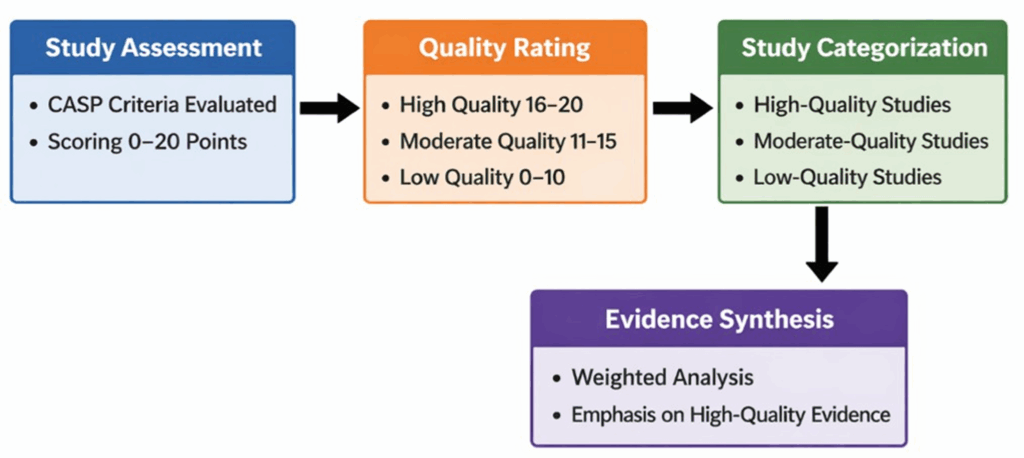
Source: Author’s illustration based on CASP (2018).
Figure 1: Application of CASP framework in study selection and synthesis
Figure 1 illustrates the application of the CASP framework in the study to enhance transparency in quality assessment. Each included study was evaluated across key methodological criteria, scored, and subsequently classified into high, moderate, or low quality. These quality ratings informed the synthesis process, with greater analytical emphasis placed on evidence derived from higher-quality studies. The full CASP scoring table for all included studies is provided in Supplementary Material to ensure transparency and reproducibility.
2.8. Data Extraction and Coding
A structured data extraction framework was employed to ensure consistency and minimize bias during synthesis. Information extracted from each study included author(s) and publication year, geographic focus, research design and methodology, sector focus within the built environment, CE practices examined (including recycling, adaptive reuse, material recovery, and circular construction), sustainability or environmental performance outcomes, and key findings and implications. Duplicate records were removed during database screening, and where overlapping datasets were identified, only the most comprehensive or recent study was retained to avoid double-counting.
To enable systematic coding of all 65 included studies, the extracted data were organized into a structured template in Microsoft Excel. Each study was coded across multiple variables, including author(s), year of publication, country or region, type of study (conceptual, empirical, policy analysis, or case study), sector within the built environment (such as residential, commercial, or construction industry), specific CE focus (reuse, recycling, resource efficiency, adaptive reuse, or circular construction), methodology employed, sample size or study scope, key findings and outcomes, relevance to policy and practice, and the CASP quality appraisal score. This coding framework ensures that all relevant information from each study can be systematically analyzed, compared, and synthesized, providing transparency and reproducibility in the review process.
A total of 65 studies were included in the systematic review and coded for synthesis. The full list of studies reviewed, along with their coding and quality assessment, is provided in Supplementary Materials.
2.9. Risk of Bias
To evaluate potential sources of systematic error, a narrative risk-of-bias assessment was conducted across the included studies. Key sources of bias identified included selection bias, as some studies were limited to specific regions or project types, reducing generalizability; reporting bias, due to inconsistent reporting of CE performance indicators across studies; measurement bias, resulting from variability in definitions and metrics of circularity, recycling, and resource efficiency; and publication bias, as there was limited reporting of negative or inconclusive findings within the literature. Although most studies demonstrated moderate to high methodological quality, these potential biases may influence the strength of the synthesized conclusions. Findings should be interpreted with consideration of methodological and contextual limitations.
During the analytical synthesis of the literature, potential distortions were given consideration. Emphasis was given to variation in research design, geographic context, and study quality where discrepancies were observed across studies to provide a fair interpretation of the available evidence.
2.10. PRISMA Flow Diagram
The selection process of studies is summarized in the PRISMA flow diagram shown in Figure 1. Initially, a total of 1,246 records were identified through the comprehensive database and supplementary searches. After removing 226 duplicate records, 1,020 unique records remained. Title and abstract screening excluded 810 records that did not focus on the circular economy in real estate. The remaining 210 full-text articles were assessed for eligibility based on the inclusion and exclusion criteria. Of these, 145 articles were excluded for reasons including non-English language, lack of explicit CE focus, absence of real estate relevance, lack of peer review, or insufficient methodological information. Ultimately, 65 studies met all inclusion criteria and were included in the final synthesis and coding process (see Supplementary Materials).
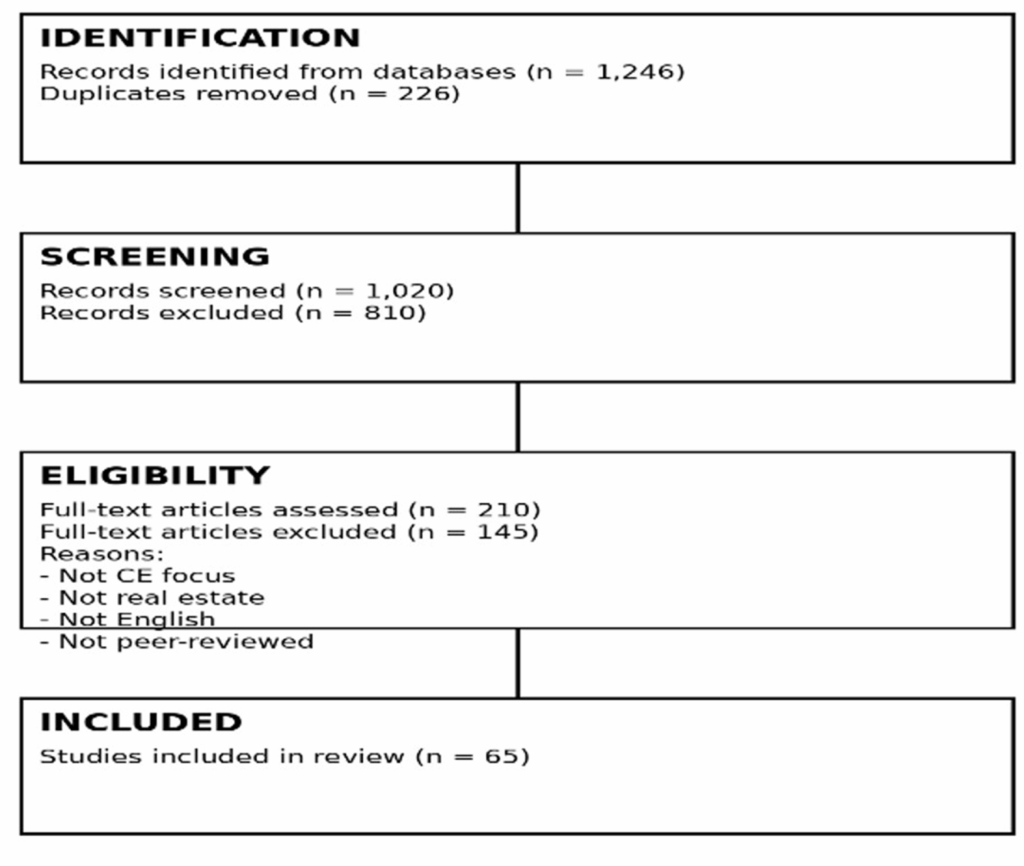
Source: Author’s compilation based on PRISMA 2020 guidelines.
Figure 2: A PRISMA 2020 flow diagram of study selection process
The PRISMA 2020 flow diagram demonstrates the study screening process across four various stages: identification, screening, eligibility, and inclusion. It shows the number of records identified, screened, excluded, and considered in the final synthesis, together with reasons for exclusion at the full-text screening stage. This improves transparency, replicability, and methodological rigor in line with systematic review reporting standards.
- Results
3.1. Descriptive Analysis
A total of 65 studies were included in the final synthesis after screening, as revealed in the PRISMA flow diagram in Figure 1 in the supplementary material. All studies summarized in Tables 3, 4, 5, 6, 7, and 8 are detailed in Supplementary Material, including coding, CASP scores, and key findings. In the geographic distribution of studies, the EU’s strong drive for circular construction, as revealed from studies from the UK, Netherlands and Scandinavian countries, contributed 25 studies (38%) [3], [8]. Asia consisted of 12 studies (18%), mostly from China and Japan, concentrating on material efficiency and green building evaluation [12], [13]. Africa provided 10 studies (15%), with Ghana, Nigeria, and South Africa as key contributors [9], [16]. North America accounted for 8 studies (12%), mainly focusing on adaptive reuse and LEED-driven circular practices [17]. The remaining 10 studies (15%) were obtained from Australia, Latin America, and global comparative reports [2], [6]. The geographical distribution of studies reviewed is summarized in Table 3, which presents a visual summary of the geographic distribution of studies included in the review.
Table 3: Geographic Distribution of Studies Included in the Systematic Review (n = 65)
| Region | Number of Studies (n) | Percentage (%) | Dominant Countries / Study Emphasis |
| Europe | 25 | 38 | UK, Netherlands, Scandinavia; policy-driven circular construction |
| Asia | 12 | 18 | China, Japan, material efficiency, and green building assessment |
| Africa | 10 | 15 | Ghana, Nigeria, South Africa: emerging circular construction practices |
| North America | 8 | 12 | Adaptive reuse and LEED-oriented circular strategies |
| Other Regions* | 10 | 15 | Australia, Latin America, and global comparative studies |
| Total | 65 | 100 | — |
Note: Other Regions consist of studies from Latin America, Australia, and global comparative reports
Source: Author’s compilation from the systematic review for this study from 2000–2024, based on included peer-reviewed journal articles, policy reports, and institutional publications.
3.1.1. Temporal Distribution of Publications
The temporal distribution of publications reveals three distinct stages. In the early 2000s, studies were few and focused largely on waste minimization in construction [18]. Between 2010 and 2016, more conceptual frameworks emerged connecting CE and the built environment [4]. From 2017 to 2024, the field expanded significantly, with increasing empirical studies, policy evaluations, and Africa-focused contributions [19].
In relation to study design, 27 studies (42%) were empirical case studies, 19 (29%) were conceptual or theoretical papers, 13 (20%) were policy and institutional analyses, and 6 (9%) were systematic or narrative reviews. Table 4 summarizes the distribution and illustrates a clear progress in publications over time. This spans from early concentration on construction waste minimization (< or = in 2009), to conceptual frameworks (2010-2016) and a noticeable increase in empirical and policy-oriented studies from 2017 onwards, with more Africa-focused research. Table 5 above emphasizes that empirical case studies dominate (42%), followed by conceptual/theoretical studies (29%) and policy analyses (20%), while systematic and narrative reviews continue to be limited (9%).
Table 4: Temporal Distribution of Publications Included in the Systematic Review (n = 65)
| Publication Period | Number of Studies (n) | Percentage (%) | Dominant Research Focus |
| Early 2000s (≤2009) | 8 | 12 | Construction waste minimization and resource efficiency |
| 2010–2016 | 18 | 28 | Conceptual frameworks linking circular economy and the built environment |
| 2017–2024 | 39 | 60 | Empirical studies, policy evaluations, and increased Africa-focused research |
| Total | 65 | 100 | — |
Source: Author’s compilation from the systematic review from 2000 to 2024 of peer-reviewed journal articles, policy reports, and institutional publications included in this study.
Table 5: Distribution of Studies by Research Design (n = 65)
| Study Design | Number of Studies (n) | Percentage (%) |
| Empirical case studies | 27 | 42 |
| Conceptual/theoretical studies | 19 | 29 |
| Policy and institutional analyses | 13 | 20 |
| Systematic or narrative reviews | 6 | 9 |
| Total | 65 | 100 |
Source: Author’s compilation from the systematic review (2000-2024) of peer-reviewed journal articles, policy reports, and institutional publications included in this study.
3.2. Thematic Results
3.2.1. Reuse in Real Estate
As shown in Table 6, reuse and material salvage are widely reported as key strategies for advancing circularity in real estate. The studies that contributed to this thematic area, along with their coding and CASP assessment, are provided in Supplementary Table 1. Reuse is essential for conserving embodied energy and heritage value, as emphasized in studies in Europe [3], [8]. Also, Adaptive reuse of obsolete buildings has been identified as a mechanism for extending asset lifespan and enhancing sustainability benefits [17]. Nevertheless, the limitations caused by insufficient funding and valuation barriers remain critical [20]. The issue of reuse linked to affordability and incremental housing is a problem in Africa, particularly in low-income areas [16].
Reuse is generally recognized as a key circular strategy; nevertheless, significant variations are evident. Studies from Europe emphasize environmental and lifecycle benefits, while evidence from African contexts highlights affordability and institutional constraints. Furthermore, though adaptive reuse may enhance asset value, valuation and funding constraints limit large-scale adoption. This suggests that reuse effectiveness is highly dependent on context.
Table 6: Evidence on Reuse in Real Estate
| Author(s), Year | Region | Focus | Methodology | Key Patterns and Results |
| Bullen & Love (2011) | Australia | Adaptive reuse for sustainability | Case studies | Environmental benefits highlighted; financial risks noted |
| Pomponi & Moncaster (2017) | UK | Reuse and embodied carbon | Life cycle analysis | Reuse reduces embodied carbon; aligns with EU CE policy |
| Adams et al. (2017) | UK | Barriers to reuse | Survey | Valuation and financing gaps are critical constraints |
| Akinmoladun & Oluwoye (2020) | Nigeria | Informal housing reuse | Qualitative analysis | Influences affordability; hindered by weak regulation |
| Leising et al. (2018) | Netherlands | Circular construction models | Conceptual framework | Reuse is positioned as a core CE strategy in construction |
Source: Author’s compilation from [17], [3], [20], [16].
3.2.2. Recycling in Property Markets
As described in Table 7, recycling, particularly the recovery of construction and demolition (C&D) waste, is another central theme. For example, China has enhanced green building performance due to improvements in recycling systems [12], [13]. Also, recycling has gained global recognition as a cornerstone of circular economy transformations [6]. Hence, the integration of recycling into building lifecycles is emphasized in Europe [3]. But studies identify slow implementation, as a result of poor infrastructure and weak policy enforcement in Africa [9].
Table 7: Evidence on Recycling in Property Markets
| Author(s), Year | Region | Focus | Methodology | Key Patterns and Results |
| Yuan et al. (2011) | China | C&D waste management | Policy analysis | Institutional reforms needed for uptake |
| Zhang et al. (2018) | China | Recycling in green buildings | Empirical evaluation | Material efficiency improvements observed |
| Pomponi & Moncaster (2017) | UK | Material loop closure | Lifecycle framework | Recycling reduces environmental impact |
| Ellen MacArthur Foundation (2019) | Global | CE roadmap | Global review | Recycling framed as basis for CE transition |
| Akomea-Frimpong et al. (2020) | Ghana | Waste recycling adoption | Mixed method | Policy weakness and infrastructure challenges noted |
Source: Author’s compilation from [3] [6], [9]. [12, [13],
Recycling is widely promoted in circular economy policies; however, a gap remains between policy ambition and implementation. Though studies from Europe and Asia emphasize strong regulatory support, evidence from African contexts points to infrastructural limitations and weak implementation. This proposes that effective recycling depends not only on policy frameworks but also on supporting infrastructure and institutional capacity.
3.2.3. Resource Efficiency
The efficient use of resources throughout a property lifecycle extends to water, energy, and material use, reason why the use of Building Information Modelling (BIM) and Internet of Things (IoT) to enhance monitoring and minimize resource use in developed economies, [10], [5]. There is evidence of improved efficiency in Chinese green buildings attributed to BIM and IoT integration [23], whereas systemic sustainability is emphasized in urban CE approaches [17]. What is common in Africa is low-cost measures such as passive cooling and water reuse, while affordability influences adoption [13]. Table 8 provides evidence on resource efficiency in real estate.
Table 8: Evidence on Resource Efficiency in Real Estate
| Author(s), Year | Region | Focus | Methodology | Key Patterns and Results |
| Bocken et al. (2016) | Europe | Business models for CE | Conceptual framework | Resource efficiency crucial to CE innovation |
| Geissdoerfer et al. (2017) | Europe | CE and sustainability | Theoretical integration | Efficiency links CE and sustainability |
| Zhang et al. (2018) | China | Green building efficiency | Empirical study | Energy and water efficiency improvements |
| Geng et al. (2019) | Asia | Urban CE and efficiency | Literature review | CE adoption linked to urban sustainability |
| Akomea-Frimpong et al. (2020) | Ghana | Resource efficiency in housing | Survey | Low-cost measures dominate; affordability constraints persist |
Source: Author’s compilation from [10], [5], [13], [29], [9].
Resource efficiency is a core component of circular economy adoption, yet a tension is evident between technological advancement and affordability. Empirical evidence from developed regions highlights digital tools such as BIM and IoT, while studies from emerging contexts emphasize dependance on low-cost, passive strategies. This implies that attaining resource efficiency necessitates context-specific approaches that harmonize innovation with affordability.
3.3. Key Patterns and Results Across Domains
The results of the integration across the thematic areas of reuse, recycling and resource efficiency show progress and persistent gaps in real estate CE adoption globally and regionally. The results showing five cross-cutting patterns derived from the synthesis are presented below:
- Strategies: Integration of reuse and recycling often overlaps, and adaptive reuse is supported by reclaimed materials [3].
- Regional differences: Europe and Asia adoption is technology-driven, while adoption in Africa is influenced by affordability and governance [9].
- Technological role: The drivers of efficiency and recycling seem to be BIM and IoT [5].
- Policy dependency: Adoption stages are significantly influenced by regulation, incentives, and valuation frameworks [11].
- Economic exchanges: high cost involved initially is the main barrier, requiring innovative funding and life-cycle costing [20].
Conclusively, CE principles in real estate are seen to be spreading and diffusing globally, although their adoption is uneven. There is advancement in framework and practice as evidenced in Europe and Asia, while challenges and possibilities for localized advancements. marked African experiences.
- Discussion:
All the studies used in the thematic area, including their coding and CASP review, are available in Supplementary Table 1. Based on the descriptive, temporal, and thematic results presented in Section 3 above, this discussion analyses findings in connection to policy, institutional frameworks, and CE adoption in real estate.
4.1. Policy and Institutional Frameworks for Circular Economy in Real Estate
Substantially, global, regional, and national policy frameworks are what shape the integration of CE principles into real estate. Collaborative international frameworks such as the United Nations Sustainable Development Goals (SDGs), the Paris Agreement, and the New Urban Agenda provide normative guidance and measurable goals that impact national and sectoral adoption [21], [22]. At the regional level, the most comprehensive CE policies, such as the European Union’s Circular Economy Action Plan, have been advanced by the European Union [23]. This is evidenced in its policies and framework on sustainable construction practices, green public procurement, and waste recycling. It is also evident in Asia, Japan’s Sound Material-Cycle Society Policy and China’s Circular Economy Promotion Law [24], which provide widely recognized legal structures promising resource efficiency.
CE integration specifically, national policies such as the National Waste Management Strategy 2020 in South Africa and the National Building Code, 2018 in Nigeria, include recovery of resources and efficient use of materials, although implementation remains weak [2], [16]. The emphasis of the African Union’s Agenda 2063 is on sustainable urbanization. In addition, advancement through regional cooperation has been provided by Donor-funded initiatives of the African Circular Economy Alliance (ACEA) [25].
An integration of these frameworks emphasizing the scope, instruments, and relevance for real estate and the built environment is shown in Table 9.
Table 9: Policy and Institutional Frameworks Supporting Circular Economy in Real Estate
| Policy/Institutional Initiative | Region/ Level | Scope/Focus | Relevance to CE in Real Estate |
| UN Sustainable Development Goals (SDGs, 2015) | Global | SDG 11 (sustainable cities), SDG 12 (responsible consumption), SDG 13 (climate action) | Institute a global reference standard for sustainable construction, waste reduction, and energy efficiency in buildings. |
| Paris Agreement (2015) | Global | Climate mitigation commitments | Indirectly enables CE by encouraging low-carbon construction and energy-efficient housing. |
| New Urban Agenda (UN-Habitat, 2017) | Global | Sustainable urbanization and housing | Promotes compact city models, sustainable housing, and CE-aligned urban design. |
| EU Circular Economy Action Plan (2020) | Regional (Europe) | Circular design, waste prevention, sustainable construction | Directly targets construction and demolition waste, adaptive reuse, and green procurement. |
| China Circular Economy Promotion Law (2009) | National (China) | Legal framework for resource efficiency | Entrenched C&D waste recycling, material reuse, and energy-efficient buildings. |
| Japan’s Sound Material-Cycle Society Policy | National (Japan) | Long-term waste reduction strategy | Stresses material recovery and lifecycle planning in real estate. |
| African Circular Economy Alliance (ACEA, 2019) | Regional (Africa) | Platform for CE collaboration | Advances CE adoption in African urban development through shared knowledge and partnerships. |
| Agenda 2063 (African Union, 2015) | Regional (Africa) | Sustainable urbanization and infrastructure | Supports African cities to integrate CE into housing and property markets. |
| South Africa National Waste Management Strategy (2020) | National (South Africa) | Waste minimization, recycling, and extended producer responsibility | Offers a basis for CE-aligned construction waste recovery. |
| Nigeria National Building Code (2018) | National (Nigeria) | Standards for building efficiency and material use | Supports effective resource use but lacks strong implementation machineries. |
Source: Compiled by the author from policy documents, institutional reports, and international frameworks relevant to circular economy adoption in real estate (China, 2009; UN, 2015; Japan, 2015; UN-Habitat, 2017; EU, 2020)
4.2. Policy-Level Key Patterns and Results
- There has been Global consistency but varied applications: International frameworks, including the SDGs and the Paris Agreement, provide aspirational targets, but their transformation into actionable policies varies significantly across regions. In comparison, Europe and parts of Asia have tougher regulatory mechanisms than Africa, where there are application gaps largely due to a lackadaisical attitude toward policy.
- Europe has remained the prominent policy leader: The EU’s Circular Economy Action Plan represents the most inclusive regional framework, directly targeting C&D waste, adaptive reuse, and sustainable procurement [23]. A regulatory template that is replicated by other regions is also provided.
- Asia pragmatic legal models: In China and Japan, CE principles have been incorporated into legally binding national laws and policies, which focus on material recovery and waste reduction. These models have validated the effectiveness of state-led legal instruments in advancing CE implementation in real estate.
- Africa’s evolving frameworks: There are regional programs such as the African Circular Economy Alliance and Agenda 2063, which demonstrate growing political commitment, even though country-level implementation has been uneven. In Nigeria, CE provisions in the building code remain under-enforced compared to South Africa, where strong institutionalization exists.
- Heightened Institutional support as a driver: Support by institutional platforms such as ACEA, UNEP, and Ellen MacArthur Foundation has been fundamental to knowledge transfer, advocacy, and funding across regions. Hence, the emphasis on the role of non-state actors in scaling CE practices in real estate.
4.3. Synthesis of Evidence Across Reuse, Recycling, and Resource Efficiency
The findings observed reveal advancement together with persistent gaps in advancing CE adoption within real estate. The synthesis shows where CE practices have been effective, limited, and shaped by policies and institutions.
4.3.1. Areas of Progress
- Adaptive Reuse and Material Recovery: Adaptive reuse and material recovery extend property lifespans and minimize demolition waste as strongly demonstrated in Europe and Asia [8], [20]. Reversible building design and circular lifecycle methods are practical technologies that offer cost benefits
- C&D Waste Recycling: China and parts of Europe are experiencing a reduction in landfill use and raw material extraction due to Mandatory recycling policies in place [12], [4]. Nevertheless, the key to scaling recycling infrastructure is effective regulatory enforcement.
- Resource Efficiency in Operations: Asia and Europe green buildings demonstrate energy, water, and material savings through lifecycle efficiency [13]. This is attributed to digital innovations, such as BIM and smart metering, enhance performance monitoring [5].
- Policy Momentum: Both the EU Circular Economy Action Plan and CE legislation in Asian supports adoption [23], [24]. However, Africa’s ACEA indicates growing commitment, but progress remains inconsistent [2].
4.3.2 Persistent Gaps
- Low Implementation in Developing Regions: Adoption of the CE is limited by financial, regulatory, and limited awareness in African and Latin American regions [9], [16].
- Disjointed Research and Application: Many studies are mostly conceptual or pilot-based, with inadequate long-term evidence [3].
- Limitation of Social Integration: Evidence of affordability, equity, and cultural adjustment persists despite documented environmental and economic benefits [26].
- Inadequate Institutional framework in Africa: Continuous lack of CE application in real estate in African countries due to weak implementation, financing, and supervisory framework, though policies exist [2], [16].
4.3.3. Cross-Cutting Insights
- Policy and Practice Harmonization: They are enforced, and there is a measurable success in CE practices in real estate in the EU and China due to enforced regulatory frameworks
- Organizational Frameworks are Key: Ellen MacArthur Foundation and ACEA organizations advance CE adoption by integrating knowledge, practice, and financing.
- Technology as Drivers: Reuse, recycling, and efficiency are consistently supported by BIM, smart metering, and material passports.
- Equal Access Considerations Remain Minimal: Sustainability and affordability challenges in CE practices in real estate are yet to be fully addressed, especially in Africa.
Drawing on Table 10, this study shows circular economy in real estate as a model of environmental, economic, financial, and transformative dimensions.
See Figure 3: Conceptual Framework of Circular Economy Integration in Real Estate (Supplementary 11)
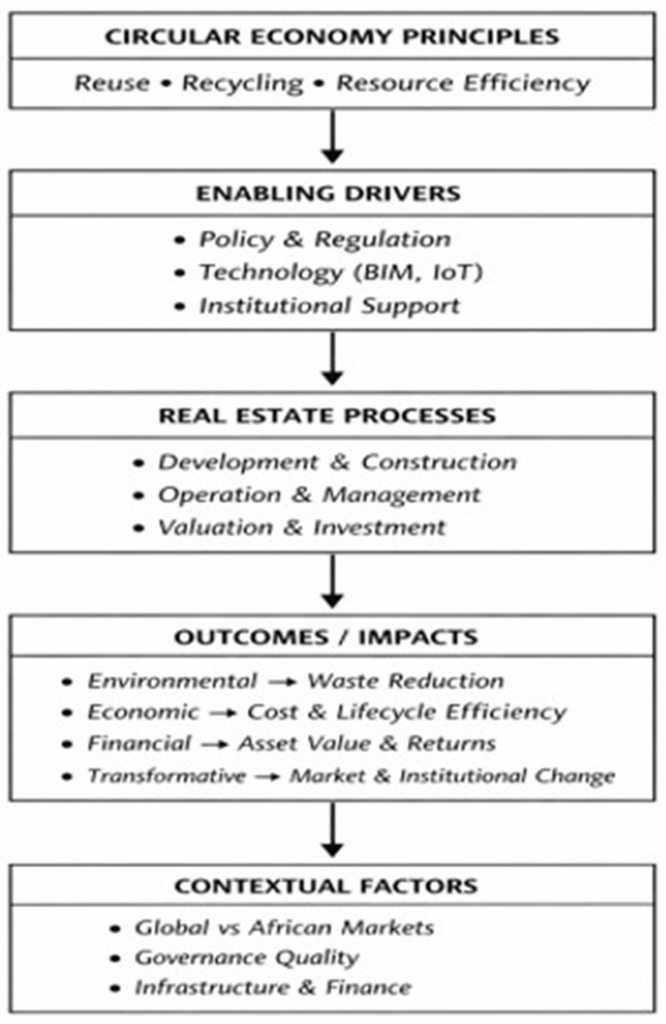
Source: Author’s conceptualization based on synthesis of reviewed studies (Table 4).
Figure 3: Conceptual Framework of Circular Economy Integration in Real Estate
4.3.4. Conceptual Integration of Circular Economy in Real Estate
The synthesis of evidence across reuse, recycling, and resource efficiency proposes that circular economy implementation in real estate operates within an integrated system rather than fragmented strategies. As shown in Figure 4.1, circular economy integration can be interpreted as a continuous interaction between policy drivers, technological enablers, market processes, and sustainability outcomes. Policy frameworks and institutional support act as foundational drivers, while technological tools such as BIM and material passports facilitate implementation. These subsequently, affect real estate outcomes including property value, lifecycle performance, and environmental impact. However, feedback mechanism persists, as market adoption and valuation practices can either strengthen or further constrain circular economy implementation.
Table 10: Integrated Conceptual Framework and Synthesis of Evidence on Circular Economy in Real Estate
| CE Theme | Areas of Progress | Persistent Gaps | Implications |
| Reuse | Strong evidence from Europe/Asia on extended lifespans, reduced waste (Leising et al., 2018; Adams et al., 2017). Design-for-disassembly, cradle-to-cradle feasible and cost-effective. | Limited adoption in Africa/Latin America due to financing, low awareness, and poor enforcement (Akomea-Frimpong et al., 2020). Few longitudinal studies. | Adaptive reuse reduces urban waste; it needs stronger policies, financing incentives, and cultural adaptation in emerging economies. |
| Recycling | China/EU show landfill reduction and material efficiency via mandatory recycling (Yuan et al., 2011; Ghisellini et al., 2016). African pilots are emerging. | Fragmented supply chains, inadequate infrastructure, lack of circular in developing regions. | Enforced regulations and investment in recycling infrastructure are critical; public procurement could drive market demand. |
| Resource Efficiency | Green buildings in Asia/Europe show consistent efficiency (Zhang et al., 2018). BIM, smart meters, and material passports enable monitoring (Geissdoerfer et al., 2017). | Social implications (affordability, inclusivity) are largely neglected (Murray et al., 2017). Limited to high-income contexts; transferability to Africa is weak. | Efficiency must integrate equity and affordability; digital solutions need local adaptation. |
| Cross-cutting (Policy & Institutions) | EU Action Plan, China CE law, and Japan policies show regulatory effectiveness. Africa’s ACEA provides a collaborative platform (UNEP, 2021). | Weak enforcement and financing in Africa; policies often aspirational (Akinmoladun & Oluwoye, 2020). | Policy-practice alignment is decisive; institutions and partnerships accelerate CE adoption but must be localized. |
Note: Various studies supporting these thematic findings, as well as the coding and CASP assessment, are available in Supplementary Table S1.
Source: Organized by the author from [2], [8], [9], [12], [13] [20], and other cited sources in the manuscript.
4.4. Strengthening the Link Between Circular Economy and Property Valuation
For the greater applicability of circular economy (CE) principles in real estate, it is essential to show how the adoption of CE impacts property value. Using a small set of quantifiable indicators can act as indicators for circular economy performance, assisting in reflecting building sustainability in such a way that valuers and investors can employ in decision-making. An illustration of the key indicators, what they measure, and how they can be incorporated into property valuation applying lifecycle cost analysis (LCC) and discounted cash flow (DCF) approaches is presented in Table 11
Table 11: Circular Economy Performance Indicators and Integration into Lifecycle Cost and Discounted Cash Flow Models
| Indicator | Definition / What It Measures | Application in Valuation |
| Embodied Carbon | Total greenhouse gas emissions from production, transport, and installation of building materials | Incorporated in LCC/DCF to account for carbon-related costs or regulatory risks. Lower embodied carbon can enhance asset value. |
| Recyclability Index | Proportion of building materials that can be recovered, reused, or recycled at the end of the building’s life | Reduces waste disposal costs and improves the circularity score. Used in lifecycle cost and cash flow calculations. |
| Building Adaptability | Ease with which a building can be modified, repurposed, or extended | Extends useful life, reduces renovation or demolition costs, and increases net present value in DCF models. |
Source: By the author.
A practical way to quantify the economic benefits of circular practices is provided by these indicators. An understanding of these indicators enables valuers, investors, and developers to make informed decisions that promote sustainable real estate development. Hence, valuation models that directly reflect buildings with high adaptability and recyclability are likely to incur lower operational and renovation costs over its lifecycle.
Overall, the review shows that implementing the CE approaches in real estate is advancing, driven by new innovative technologies, emerging sustainability approaches and international regulatory frameworks. Nevertheless, there remains a clear gap between developed and developing countries, particularly in organizational capacity, financial support, and policy enforcement. Mitigating these gaps will require better regulatory alignment, more investment in sustainable infrastructure, and enhanced integration of circular performance indicators into property valuation and investment decisions. Future research should focus on testing circular valuation indicators and creating context-specific models for developing economies.
- Future Research Directions:
5.1. Technological Innovations: Blockchain, BIM, and IoT
The technology of BIM currently facilitates reversible building design, virtual representation of physical assets, and lifecycle tracking of materials [5]. Expanding BIM integration with material documentation and a lifecycle database of products could significantly enhance material recovery rates. The application of IoT, such as smart sensors, supports real-time monitoring of energy, water, and material use. This makes it possible for smart buildings to operate as flexible adaptive systems [13]. Also, the use of Blockchain has emerged as a tool for ensuring transparency in circular procurement. It helps to create online marketplaces where recycled materials and reused building components can be traded with trust and traceability [27].
Gaps persist in that most technological applications are piloted in Europe and East Asia, while limited transferability still exists in African and Latin American contexts. This research suggests that future studies should assess how these tools can be modified in regions with limited digital infrastructure, dispersed supply chains, and affordability challenges. The possibility of technology adaptation for emerging economies makes progress toward sustainable development in real estate significant. This also marks a tremendous advancement in achieving sustainable global goals.
5.2. Valuation Metrics for Circular Real Estate
Valuation’s current approach focuses on location, income potential, and building quality, but fails to incorporate resource efficiency, adaptability, and reduced lifecycle costs [3]. Studies indicate the incorporation of circularity performance measures, including material intensity per square meter, building adaptability, materials associated with carbon emissions and recyclability index into valuation frameworks [20].
The integration of CE metrics into real estate valuation encourages investors and developers to adopt sustainable practices, informs policymakers to align incentives with measurable outcomes, and to support financing through green and impact-focused instruments
The focus of future research should be to establish strong, context-specific models for integrating circularity into valuation, particularly in Africa, common with informal housing markets and weak enforcement of standard valuation practices.
5.3. Circular Economy and Affordable Housing Integration
Aligning CE strategies with the urgent need for affordable housing has become a major challenge globally. While circular design and reuse can lower construction costs over time, initial investment and technology necessities may raise immediate costs [28]. In low and middle-income countries, where housing deficits are acute, circularity risks is often perceived as a “luxury” rather than a necessity [9].
Future studies should examine low-cost circular construction techniques, such as modular housing using locally recycled materials, adaptive reuse of public buildings for social housing, and community-based recycling enterprises. Crucial to mainstreaming CE in affordable housing delivery is the existence of partnerships between governments, housing cooperatives, and private developers. Additionally, integrating circular housing initiatives into wider urban planning is essential because it involves connecting circular housing with waste management, renewable energy, and infrastructure provision, which could yield synergistic benefits for sustainable development.
Overall, these research directions emphasize the need to tailor circular economy concepts to regional contexts, incorporate technology and valuation methods, and harmonize sustainability with affordability to promote adoption in emerging real estate markets.
- Conclusion and Recommendations:
- 6.1. Conclusion
- 6.1.1 Summary of Findings
Based on this review, CE adoption in real estate globally remains at an emerging stage. Europe and parts of Asia are leading in CE adoption, attributed to strong policy frameworks and industry innovation, while Africa and other emerging regions continue to lag. Opportunities such as adaptive reuse, recycling of C & D waste, and incorporation of green building practices are the main emphasis, while weak regulatory support, limited financing, and low stakeholder awareness barriers persist.
- 6.1.2.Theoretical Contribution
Theoretically, circular economy in real estate has been positioned not only as an environmental strategy but also as an economic, transformative, and financial model, adding to the growing body of academic knowledge. The study leverages perspectives from sustainability, construction management, and property valuation to prove how CE principles can restructure notions of value, risk, and lifecycle performance in the built environment. It also shows how CE transformation can be conceptualized within real estate markets by integrating global and regional evidence,
- 6.1.3. Practical and Policy Implications
For implementation purposes, the findings of the study offer the necessity for valuers, investors, and developers to adopt lifecycle thinking by incorporating material efficiency, adaptability, and long-term resilience into property development. The study recommends that policymakers formulate enabling regulatory and financial frameworks to promote circular construction, recycling industries, and integrate CE indicators into urban housing policies. Affordable housing is a crucial priority in African and CE practices can provide a pathway, reduce costs and waste, and improve social impacts if context-specific strategies are designed.
- 6.2. Recommendations
The following recommendations are proposed based on the findings of the systematic review to strengthen circular economy practices in real estate and property markets:
- Strengthen Policy and Regulatory Frameworks: Well-defined regulations and supportive measures that support reuse, recycling, and resource efficiency in the built environment should be put in place by the governments. These measures should include mandatory recycling targets for construction and demolition waste, support mechanisms for adaptive reuse, and penalties for non-compliance. Regions with weak governance will require strong regulatory frameworks to effectively advance circular economy practices. [21], [22].
- Integrate Circular Economy into Property Valuation and Financing: Valuation framework should incorporate the value of reused and recycled materials, lifecycle costs, and reduced environmental impact, which will help attract investment and improve economic viability of circular projects. This is to ensure that circular projects are not undervalued in valuation [3], [20].
- Promote Research and Data Collection in Emerging Markets: Several empirical studies on market demand, cost-benefit analysis, policy impact, and challenges to circular economy implementation in emerging economies and African property markets are critical. For better informed policy and practice, data collection on construction waste, material flows, and building lifecycle performance should be strengthened [3], [26].
- Encourage Public-Private Partnerships (PPPs): There should be government collaboration with private sector stakeholders, industry associations, and academia to expand circular economy practices. For example, PPPs can support the development of recycling infrastructure, material recovery facilities, and circular construction supply chains. Additionally, such collaboration helps build capacity and facilitates the sharing of best practices throughout regions [21], [22].
- Support Technology Adoption with Contextual Adaptation: Technological tools, including BIM and IoT, can improve resource efficiency, but should be adapted to local contexts. To ensure resource efficiency is achievable across varied economic contexts, affordable and practical technologies should be promoted together with capacity building and training programs [27], [20].
- Strengthening CE-Valuation Link: Applying small measures, such as building associated with carbon emission, circular material performance index, and building adaptability, can help assess circular economy performance in real estate. Integrating these indicators in Lifecycle Cost (LCC) and Discounted Cash Flow (DCF) models helps prove the economic benefits of circular practices. For instance, buildings that are more adaptable or use more recyclable materials can add value by lowering operating and renovation costs, extending their useful life, and increasing their overall value. This approach offers a clear financial justification for adopting circular economy approaches.
Authorship Contributions Statement: Dr (Mrs) P. O. Iruobe is the sole author of this review and was fully responsible for all aspects of the study, including conceptualization; methodology; data collection and curation; formal analysis; writing – original draft; writing – review and editing; visualization; and project administration.
Acknowledgement: The research recognizes all scholars whose works were reviewed and appreciates the University of Benin for providing access to scholarly resources that supported this review.
Declaration of competing interest: The author affirms that there is no conflict of interest related to this study.
Data availability: All data generated or analyzed during this study are included in this published article and its supplementary materials. The structured dataset of included studies, containing metadata and quality appraisal outcomes, is provided as Supplementary.
References:
[1] World Bank, The Circular Economy in the Built Environment: Unlocking Opportunities. Washington, DC, USA: World Bank Group, 2020.
[Online]. Available: https://reports.weforum.org/docs/WEF_Circularity_in_the_Built_Environment_2024.pdf
[2] United Nations Environment Programme (UNEP), Global Status Report for Buildings and Construction: Towards a Zero-Emission, Efficient and Resilient Buildings and Construction Sector. Nairobi, Kenya: UNEP, 2021.
[Online]. Available: https://digitallibrary.un.org/record/3995803?v=pdf
[3] F. Pomponi and A. Moncaster, “Circular economy for the built environment: A research framework,” Journal of Cleaner Production, vol. 143, pp. 710–718, 2017.
doi: https://doi.org/10.1016/j.jclepro.2016.12.055
[4] P. Ghisellini, C. Cialani, and S. Ulgiati, “A review on circular economy: The expected transition to a balanced interplay of environmental and economic systems,” Journal of Cleaner Production, vol. 114, pp. 11–32, 2016.
doi: https://doi.org/10.1016/j.jclepro.2015.09.007
[5] M. Geissdoerfer, P. Savaget, N. M. P. Bocken, and E. J. Hultink, “The circular economy – A new sustainability paradigm?” Journal of Cleaner Production, vol. 143, pp. 757–768, 2017.
doi: https://doi.org/10.17863/CAM.7193
[6] Ellen MacArthur Foundation, Completing the Picture: How the Circular Economy Tackles Climate Change. Cowes, UK, 2019.
[Online]. Available: https://www.ellenmacarthurfoundation.org/completing-the-picture
[7] Buildings As Material Banks (BAMB), Buildings as Material Banks: A Pathway Towards a Circular Built Environment. Brussels, Belgium: BAMB Project Consortium, 2019.
[Online]. Available: https://www.bamb2020.eu/
[8] J. Leising, J. Quist, and N. M. P. Bocken, “Circular economy in the building sector: Three cases and a collaboration tool,” Journal of Cleaner Production, vol. 176, pp. 976–989, 2018.
doi: https://doi.org/10.1016/j.jclepro.2017.12.010
[9] H. R. Sayarshad, V. Mahmoodian, H. O. Gao, “Non-myopic dynamic routing of electric taxis with battery swapping stations” Sustainable Cities and Society, vol. 57, Art. no. 102113, 2020.
doi: https://doi.org/10.1016/j.scs.2020.102113
[10] N. M. P. Bocken, I. de Pauw, C. Bakker, and B. van der Grinten, “Product design and business model strategies for a circular economy,” Journal of Industrial and Production Engineering, vol. 33, no. 5, pp. 308–320, 2016.
doi: https://doi.org/10.1080/21681015.2016.1172124
[11] D. Reike, W. J. V. Vermeulen, and S. Witjes, “The circular economy: New or refurbished as CE 3.0?” Resources, Conservation and Recycling, vol. 135, pp. 246–264, 2018.
doi: https://doi.org/10.1016/j.resconrec.2017.08.027
[12] N. Wang “The role of the construction industry in China’s sustainable development,” Habitat International, vol. 44, pp. 442-450, 2014.
doi: https://doi.org/10.1016/j.habitatint.2014.09.008
[13] X. Zhang, L. Shen, and Y. Wu, “Green strategy for gaining competitive advantage in housing development,” Journal of Cleaner Production, vol. 168, pp. 1290–1299, 2018.
doi: https://doi.org/10.1016/j.jclepro.2010.08.005
[14] D. Moher, A. Liberati, J. Tetzlaff, D. G. Altman “Preferred reporting items for systematic reviews and meta-analyses: The PRISMA statement,” PLoS Medicine, vol. 6, no. 7, Art. no. e1000097, 2009. doi: https://doi.org/10.1371/journal.pmed.1000097
[15] M. J. Page et al., “The PRISMA 2020 statement,” BMJ, vol. 372, Art. no. n71, 2021.
doi: https://doi.org/10.1136/bmj.n71
[16] O. A. Akinmoladun and J. O. Oluwoye, “Circular economy adoption in the Nigerian construction industry,” Journal of Sustainable Development in Africa, vol. 22, no. 3, pp. 45–60, 2020. [Online]. Available: https://www.jsd-africa.com
[17] P. A. Bullen and P. E. D. Love, “Adaptive reuse of heritage buildings,” Structural Survey, vol. 29, no. 5, pp. 411–421, 2011.
doi: https://doi.org/10.1108/02630801111182439
[18] M. R. Chertow, “Industrial symbiosis: Literature and taxonomy,” Annual Review of Energy and the Environment, vol. 25, pp. 313–337, 2000.
doi: https://doi.org/10.1146/annurev.energy.25.1.313
[19] A. W. L. Ee, S. J. Chew, H. H. Khoo, A, T. S. Ng, and H. W. Kua, “Circular economy for the building industry: Life cycle assessment of biochar-enhanced concrete” Resources, Conservation and Recycling, vol. 223, no. 108537, 2025. https://doi.org/10.1016/j.resconrec.2025.108537
[20] K. T. Adams, M. Osmani, T. Thorpe, and K. Thornback, “Circular economy in construction: Current awareness, challenges and enablers,” Proceedings of the Institution of Civil Engineers – Waste and Resource Management, vol. 170, no. 1, pp. 15–24, 2017.
doi: https://doi.org/10.1680/jwarm.16.00011
[21] United Nations, Transforming Our World: The 2030 Agenda for Sustainable Development. New York, NY, USA, 2015.
[Online]. Available: https://sdgs.un.org/2030agenda
[22] UN-Habitat, Sustainable Urbanization in the Paris Agreement. Nairobi, Kenya, 2017.
[Online]. Available: https://unhabitat.org
[23] European Commission, A New Circular Economy Action Plan: For a Cleaner and More Competitive Europe. Brussels, Belgium, 2020. [Online]. Available: https://environment.ec.europa.eu/strategy/circular-economy-action-plan_en
[24] National People’s Congress of the People’s Republic of China, Circular Economy Promotion Law of the People’s Republic of China. Beijing, China, 2009.
[Online]. Available: http://www.npc.gov.cn/englishnpc/law/2009-02/28/content_1471583.htm
[25] European Automobile Manufacturers’ Association (ACEA), Circular Economy: Building a Sustainable Automotive and Industrial Value Chain. Brussels, Belgium, 2019.
[Online]. Available: https://www.acea.auto/nav/?content=publications
[26] A. Murray, K. Skene, and K. Haynes, “The circular economy: An interdisciplinary exploration of the concept and application in a global context,” Journal of Business Ethics, vol. 140, no. 3, pp. 369–380, 2017. doi: https://doi.org/10.1007/s10551-015-2693-2
[27] P. Lacy, J. Long, and W. Spindler, The Circular Economy Handbook: Realizing the Circular Advantage. London, UK: Palgrave Macmillan, 2020.
doi: https://doi.org/10.1057/978-1-349-95968-6
[28] V. Rizos, A. Behrens, K. Kafyeke, A. Hirschnitz-Garbers, and C. Ioannou, “The circular economy: Barriers and opportunities for SMEs,” CEPS Working Document No. 412, Brussels, Belgium, 2016. [Online]. Available: https://www.ceps.eu/ceps-publications/circular-economy-barriers-and-opportunities-smes/
[29] Y. Geng, J. Sarkis, and R. Bleischwitz, “How to globalize the circular economy,” Nature, vol. 565, no. 7738, pp. 153–155, 2019.
doi: https://doi.org/10.1038/d41586-019-00017-z